

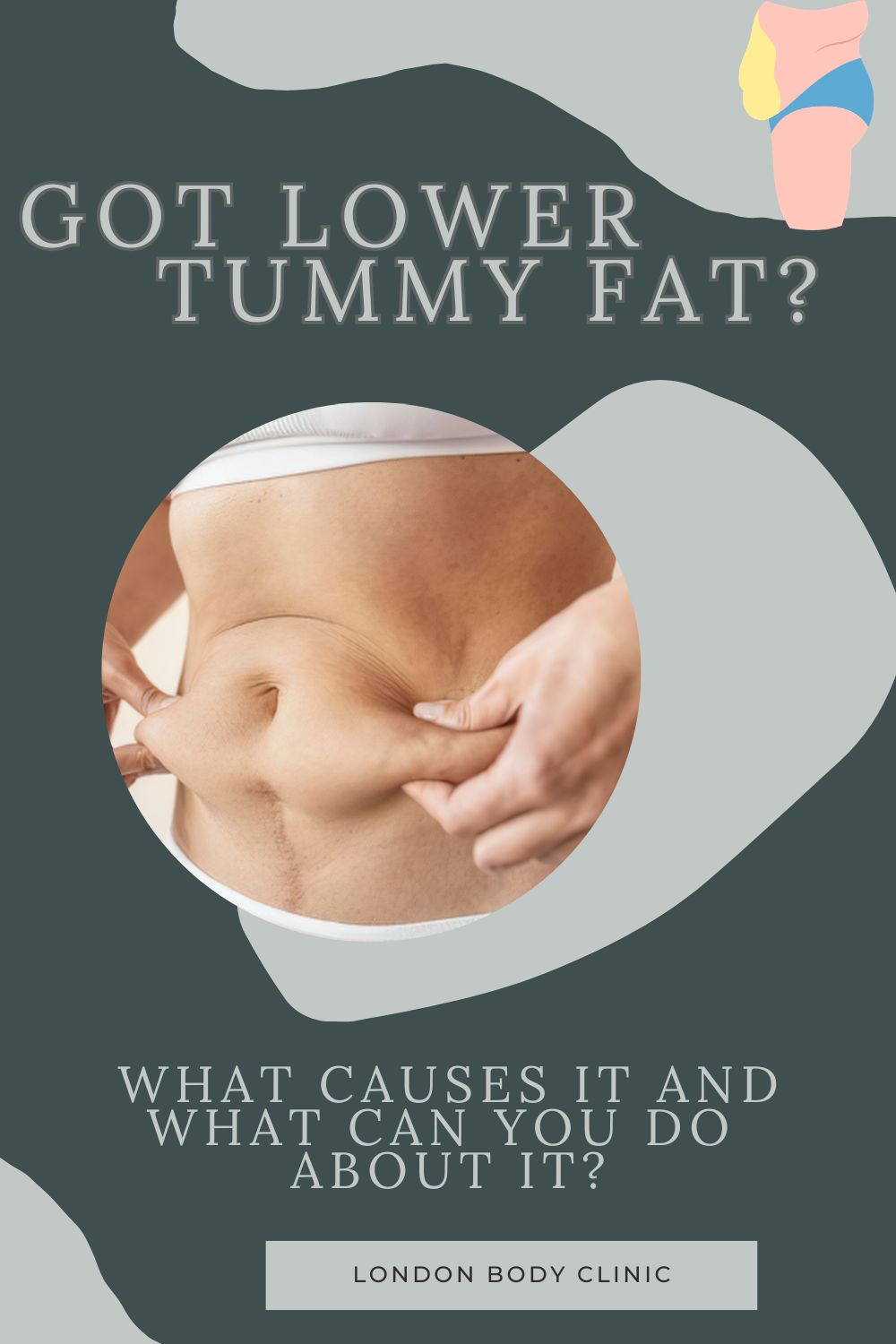
Got Lower Tummy Fat? What Causes It and What Can You Do About It?
That stubborn little pocket of fat below the belly button.
You eat well. You exercise. Your weight may even be exactly where you want it to be — but somehow your lower tummy still refuses to cooperate.
For many women, particularly after pregnancy or as they move through their 30s and 40s, the lower abdomen can become one of the most frustrating areas of the body.
It is often called a “mummy tummy”, lower belly pouch, lower abdominal fat or stubborn tummy fat — but what actually causes it?
The answer isn’t always simply “too much fat”.
At London Body Clinic, we regularly see clients who are unhappy with their lower abdomen, and there can actually be several things contributing to its appearance: subcutaneous fat, stretched or loose skin, pregnancy-related changes, muscle separation, genetics, hormones, age and lifestyle factors.
Understanding what is creating the tummy is therefore the first step towards deciding what — if anything — is worth treating.
What Is a “Mummy Tummy”?
“Mummy tummy” isn’t a medical diagnosis. It’s an everyday term commonly used to describe the softer, rounded or pouch-like appearance that can remain around the lower abdomen following pregnancy.
Pregnancy can stretch the abdominal wall considerably. The NHS explains that the two abdominal muscles can separate as the uterus grows, a condition known as diastasis recti or divarication.
More recent NHS guidance describes diastasis rectus abdominis as a widening and thinning of the connective tissue between the abdominal muscles, producing laxity of the abdominal wall.
But not every “mummy tummy” is diastasis recti.
What you’re seeing could be:
- Localised subcutaneous fat
- Loose or stretched abdominal skin
- Reduced skin firmness
- Diastasis recti
- Changes in the abdominal wall following pregnancy
- A combination of several of these
And you certainly don’t need to have had a baby to develop a lower abdominal pouch.
Why Is Lower Tummy Fat So Stubborn?
Where we store fat is influenced by numerous factors including genetics, age, hormones, lifestyle and overall body composition.
Some people naturally store more around their hips and thighs, while others carry more around their abdomen.
It’s also important to understand that you cannot choose where your body loses weight first.
Someone can therefore lose significant overall body weight and still feel that their lower abdomen looks disproportionately full.
And sometimes what looks like “fat” isn’t entirely fat.
If the skin has become loose following pregnancy or significant weight loss, simply reducing more body fat may not produce the flatter or firmer appearance someone expects.
That’s why assessment matters.
Pregnancy and the Lower Tummy Pouch
Pregnancy changes the abdomen enormously.
The skin stretches, the abdominal wall expands and the muscles adapt to accommodate the growing baby.
After birth, these structures need time to recover. The NHS notes that a post-pregnancy abdominal bump can remain for weeks or months while stretched muscles recover.
Some women are left predominantly with fat.
Others have predominantly skin laxity.
Some have diastasis recti.
And many have a combination.
This is why two women with apparently similar lower tummies may need completely different approaches.
Can Cortisol Cause Belly Fat?
This is one of the biggest conversations online at the moment — the so-called “cortisol belly.”
Cortisol is an important hormone involved in your body’s stress response. It isn’t inherently bad; we need it.
There is scientific evidence linking chronic stress, glucocorticoid activity and abdominal fat distribution. Research has found associations between long-term cortisol exposure and abdominal obesity, while studies of the stress-response system suggest that cortisol regulation may influence where some people accumulate fat.
But here’s the important part:
Having belly fat does not mean that you have a cortisol problem.
A systematic review found that although abdominal fat and HPA-axis/cortisol activity are related, findings across studies are not completely consistent.
So we wouldn’t look at somebody’s stomach at London Body Clinic and tell them, “That’s cortisol belly.”
That’s far too simplistic.
Chronic stress may also indirectly influence weight through sleep, appetite, food choices and activity levels.
If you have symptoms that make you concerned about an underlying hormonal or medical problem, that belongs with your GP or appropriate medical professional, rather than being diagnosed by an aesthetic or body-contouring clinic.
Subcutaneous Fat vs Visceral Fat: What’s the Difference?
This distinction is particularly important.
Subcutaneous fat sits underneath the skin. This is the softer fat you can generally pinch.
Visceral fat sits deeper within the abdomen around internal organs.
Belly fat can contain both.
Cosmetic body-contouring treatments are not a treatment for dangerous levels of visceral fat, obesity or metabolic disease.
Our treatments are aimed at appropriately selected clients looking to improve localised cosmetic concerns, rather than replace healthy nutrition, exercise, weight management or medical care.
How Do We Treat Lower Tummy Fat at London Body Clinic?
This is where having several technologies available becomes particularly useful.
At London Body Clinic, we don’t believe every tummy should automatically receive the same treatment.
We first need to decide:
Is the main concern fat, loose skin, or both?
Depending on your assessment, options available at London Body Clinic include body-contouring treatments such as fat dissolving treatments, HIFU, non-invasive laser lipo and radio-frequency-based treatments. Our current treatment range includes HIFU, laser-lipo pad treatment and other body-contouring options.
Fat Dissolving Treatments
For someone with a small, localised pocket of pinchable lower abdominal fat, a fat-dissolving treatment may be considered following consultation.
These treatments are intended for localised areas rather than general weight loss.
Treatment suitability, product choice and the number of sessions required depend on the individual.
HIFU for the Tummy
High-Intensity Focused Ultrasound (HIFU) uses focused ultrasound energy and is used within aesthetic practice for body and skin-contouring applications.
It may be considered where the objective is improving the appearance of a particular area rather than achieving general weight loss.
At London Body Clinic we offer HIFU for the face, neck and body.
Non-Invasive Laser Lipo
Our laser lipo pad treatment is a non-invasive treatment performed externally using pads placed over the treatment area.
There are no incisions and no surgical liposuction involved.
London Body Clinic currently offers laser-lipo pad treatment for targeted body contouring.
This can be incorporated into a body-contouring programme where appropriate following consultation.
Radio Frequency for Loose Tummy Skin
Sometimes the client’s biggest concern isn’t actually the amount of fat.
It’s the skin sitting over it.
This is particularly common following pregnancy or substantial weight loss.
Radio-frequency-based treatments may therefore be considered when skin laxity is contributing to the appearance of the abdomen.
This is exactly why simply saying “I want my tummy fat removed” doesn’t always tell us what treatment is actually appropriate.
What If I Have Both Fat AND Loose Skin?
Very often, you do.
And this is where a combination approach may make more sense than trying to force one treatment to do everything.
For example, a treatment plan might focus first on the localised fatty area and then address skin quality or laxity.
There isn’t one universal combination or number of sessions because the right approach depends on what we see during consultation.
Why We Assess Before We Treat
One of the most important parts of body contouring is knowing when not to treat something as fat.
If your abdominal appearance is substantially related to diastasis recti, for example, reducing superficial fat isn’t going to repair separated abdominal muscles.
The NHS advises speaking to your GP if abdominal muscle separation remains obvious after pregnancy; physiotherapy and appropriate exercises may be recommended.
Likewise, unexplained abdominal swelling, pain, a suspected hernia or other unusual symptoms require appropriate medical assessment.
Good body contouring starts with identifying what we’re actually looking at.
Frequently Asked Questions About Lower Tummy Fat
What causes lower tummy fat in women?
There isn’t one cause. Genetics, overall body composition, age, lifestyle, pregnancy and hormonal factors can all influence abdominal appearance. Loose skin and abdominal muscle changes can also create the appearance of a lower tummy pouch even when fat isn’t the only issue.
What is a mummy tummy?
“Mummy tummy” is an informal term describing a persistent pouch or rounded appearance of the abdomen after pregnancy. It can involve fat, stretched skin, abdominal wall changes or diastasis recti.
Can you have a mummy tummy without having children?
Yes. A similar lower abdominal pouch can occur in people who have never been pregnant. Genetics, fat distribution, weight changes, skin laxity and other factors can all influence the lower abdomen.
Is lower belly fat caused by cortisol?
Not necessarily. Research suggests an association between cortisol/stress regulation and abdominal fat, but the relationship is complex. Belly fat alone cannot tell you whether your cortisol levels are abnormal.
What does a cortisol belly look like?
There isn’t a clinically reliable appearance that allows someone to diagnose a “cortisol belly” by looking at you. If you’re concerned about cortisol or another hormonal condition, speak to your GP.
Why do I have a lower tummy pouch even though I’m slim?
Slim people can still carry a localised layer of subcutaneous fat around the lower abdomen. Skin laxity, posture and abdominal wall changes can also influence its appearance.
Why won’t my lower tummy go away when I lose weight?
Your body determines where it stores and loses fat, and localised areas can remain even after overall weight loss. In addition, what appears to be stubborn fat may partly be loose skin or changes to the abdominal wall.
Can pregnancy cause permanent changes to the stomach?
Pregnancy can cause lasting changes in skin, connective tissue and abdominal muscles. Diastasis recti can also persist in some women after pregnancy.
How do I know whether I have tummy fat or loose skin?
Often it’s a combination. An in-person assessment can help determine whether the concern appears predominantly related to pinchable subcutaneous fat, skin laxity or something requiring medical assessment.
Can HIFU be used on the lower tummy?
HIFU can be used in body-contouring applications in appropriately selected clients. Suitability should be established during consultation.
Does London Body Clinic offer non-surgical tummy treatments?
Yes. Our current treatment range includes non-invasive and minimally invasive options used for body-contouring concerns, including HIFU and laser-lipo pad treatments, with other options considered according to individual suitability.
Is laser lipo the same as liposuction?
No. London Body Clinic’s laser-lipo pad treatment is non-invasive and uses external pads. It is not surgical liposuction.
Can body contouring treat visceral fat?
Cosmetic body contouring should not be presented as treatment for visceral obesity or metabolic disease. Visceral fat lies deeper around the abdominal organs and carries health implications that are different from cosmetic subcutaneous fat.
Can body contouring replace diet and exercise?
No. Body contouring is intended to address specific cosmetic concerns in suitable clients. It isn’t a substitute for healthy lifestyle habits or medical weight management.
What is the best treatment for a mummy tummy?
There isn’t one “best” treatment. If the concern is predominantly localised fat, the approach may differ from somebody whose main issue is loose skin or abdominal muscle separation. That’s why we recommend assessment before deciding on treatment.
Ready to Understand What’s Really Causing Your Lower Tummy?
If you’ve been calling it your mummy tummy, lower belly pouch or stubborn tummy fat, the first thing we want to establish is what’s actually creating the appearance you’re unhappy with.
At London Body Clinic, we’ll assess the area and discuss which of our body-contouring options may be appropriate for you — and we’ll tell you when we don’t think a cosmetic treatment is the right answer.
Book your consultation with London Body Clinic and let’s create a treatment plan based on your body, rather than a one-size-fits-all solution.
With Love
Aunty Nas