

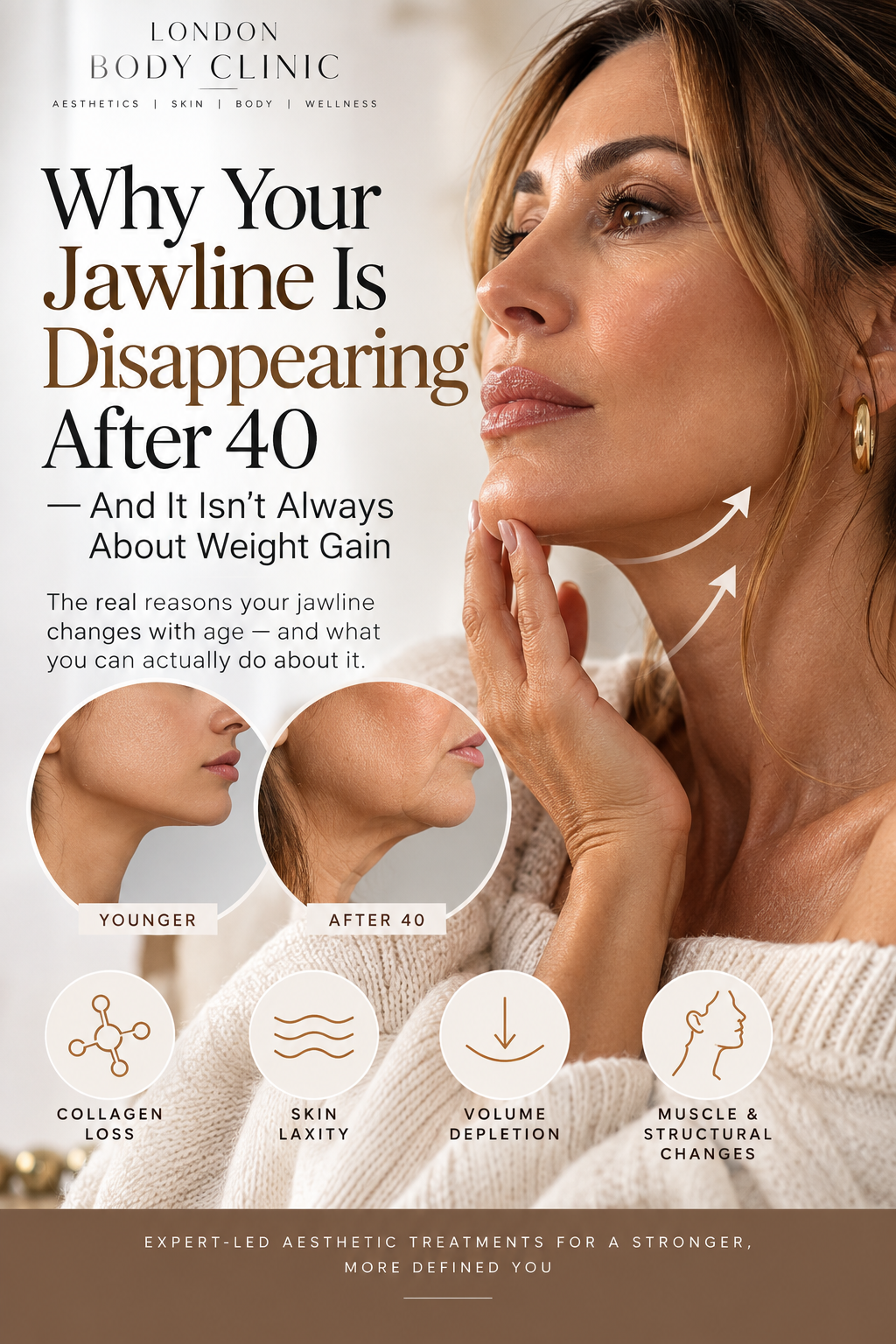
Why Your Jawline Is Disappearing After 40 — And It Isn’t Always About Weight Gain
Why Your Jawline Is Disappearing After 40 — And It Isn’t Always About Weight Gain
Have you started avoiding photographs taken from the side?
Maybe you automatically lift your chin when someone gets their phone out. Perhaps you catch yourself pulling the skin beside your jaw backwards in the mirror, wondering where the sharper jawline you used to have has gone.
And one of the most frustrating parts?
Your weight might not have changed at all.
For many women, changes around the jawline become much more noticeable during their 40s and 50s. The lower face can begin to look heavier, jowls may become more apparent and the once-clear line between the face and neck can gradually become softer.
It is easy to assume this is simply weight gain or “extra fat” under the chin.
But facial ageing is much more complicated than that.
Changes in skin quality, collagen, facial volume, underlying support and the tissues of the lower face can all influence how defined your jawline looks.
At London Body Clinic, we believe the first step isn’t choosing a treatment. It is understanding why your face has changed in the first place.
Why does your jawline change as you get older?
When we think about ageing, we often focus on wrinkles.
But ageing doesn’t only happen on the surface of the skin.
Your face is made up of multiple layers, including skin, fat, muscles and underlying structural support. Changes across these layers can alter the overall shape and proportions of your face over time.
That means the jawline you see at 45 may look different from the one you had at 30, even if the number on the scales hasn’t changed dramatically.
Here are some of the factors that can contribute.
1. Collagen and elastin decline
Collagen provides structural support to the skin, while elastin contributes to its ability to stretch and return towards its original position.
As we age, the skin’s supportive properties change.
The result can be skin that doesn’t feel quite as firm or resilient as it once did.
You may first notice this when applying skincare or makeup. Perhaps the skin around your jaw feels softer. You may notice a small fold beside your mouth or the beginnings of a jowl that wasn’t there a few years ago.
Over time, these changes can make the lower face appear less defined.
And unfortunately, this isn’t something weight loss alone can necessarily correct.
2. Your face can lose volume while your lower face looks heavier
This sounds contradictory, but it is an important part of understanding facial ageing.
You can lose volume in certain areas of your face while simultaneously feeling as though the bottom of your face has become heavier.
Changes in the cheeks and mid-face can affect the overall balance and contours of the face.
This is one reason why simply looking at the jawline in isolation doesn’t always give us the whole picture.
When we assess facial ageing at London Body Clinic, we want to understand what is happening throughout the face rather than automatically deciding that every changing jawline needs exactly the same treatment.
3. Skin laxity can create the appearance of jowls
One of the biggest complaints we hear is:
“I feel like my face is dropping.”
What many clients are describing is increased laxity around the lower face.
When the skin and supporting tissues aren’t behaving in quite the same way they did when you were younger, the crisp line of the jaw can become softer.
Small pockets or folds can appear either side of the chin.
These are commonly described as jowls.
For some women they’re barely noticeable from the front but become much more obvious in photographs taken from an angle.
And that explains another behaviour we see all the time…
You pull the skin beside your ears backwards with your fingers and think:
“If it could just stay THERE.”
You’re not imagining the change. But understanding what’s contributing to it is essential before deciding what to do about it.
4. The problem may not actually be your jaw
This is where aesthetic assessment becomes particularly important.
Sometimes the area bothering you isn’t necessarily the area that needs to be treated.
The appearance of the jawline can be influenced by the proportions of the chin, cheeks, neck and surrounding tissues.
For example, someone may arrive asking for treatment specifically for their jowls when their overall lower-face proportions need to be assessed first.
This is why we don’t believe in choosing aesthetic treatments because you’ve seen somebody else’s before-and-after photograph.
Their anatomy isn’t your anatomy.
Their ageing pattern isn’t your ageing pattern.
And their treatment plan shouldn’t automatically become yours.
5. Weight changes CAN affect the jawline — but they’re not the only cause
Of course, changes in weight can alter facial appearance.
Some people naturally store more fat beneath the chin or around the lower face, while weight gain can make this area more noticeable.
But equally, significant weight loss can sometimes make skin laxity more visible.
This is particularly relevant for women who have lost a substantial amount of weight and are delighted with the changes to their body but suddenly feel that their face looks older.
The answer isn’t necessarily to lose more weight.
If the primary concern is skin laxity or changes in facial support, additional weight loss may not address what you are seeing.
6. Hormonal changes may coincide with changes in your skin
For many women, their 40s are also a period of significant hormonal change.
Perimenopause and menopause can coincide with noticeable changes in skin hydration, texture and firmness.
This can feel incredibly sudden.
You may look at photographs from only a few years ago and wonder why your face appears different despite using good skincare, exercising and taking care of yourself.
It doesn’t mean you’ve suddenly “aged badly.”
It means facial ageing is multifactorial — and understanding those factors allows us to make much more sensible treatment decisions.
Can skincare tighten a sagging jawline?
Good skincare absolutely has a role in maintaining healthy-looking skin.
Daily broad-spectrum SPF, appropriate active ingredients and a consistent skincare routine can all be valuable.
But there is an important distinction between improving the surface quality of your skin and addressing deeper changes associated with facial ageing.
A cream can help moisturise your skin.
It cannot physically recreate every structural feature of the face you had at 25.
And that’s why endlessly buying stronger creams isn’t always the answer when the concern is primarily laxity or loss of definition.
What treatments can help improve jawline definition?
There isn’t one universal “best treatment for jowls.”
The appropriate option depends on what is actually causing the concern, your anatomy, medical history, expectations and the degree of change present.
At London Body Clinic, treatment options that may be considered following consultation include:
Morpheus8 RF Microneedling
Morpheus8 combines microneedling with radiofrequency energy.
For suitable clients, it may be considered when concerns include skin laxity, texture and overall skin quality around areas such as the lower face, jawline and neck.
Rather than thinking of it as a treatment that magically “lifts your face,” we prefer to be realistic about what non-surgical treatments are designed to achieve.
The aim is improvement — not pretending a device can reproduce the results of surgery.
HIFU
High-intensity focused ultrasound — commonly known as HIFU — is another non-surgical technology that may be considered for suitable clients concerned about facial and neck laxity.
Energy is delivered at targeted depths beneath the skin, and treatment suitability should always be determined following assessment.
Again, more treatment is not automatically better. Appropriate treatment selection matters.
Skin boosters
Sometimes a client’s concern isn’t simply the shape of the jawline.
The skin itself may look dehydrated, crepey or less luminous than it once did.
Skin boosters may be considered where improving hydration and overall skin quality forms part of the treatment objective.
They are not the same as dermal filler and aren’t intended simply to create a bigger or heavier-looking face.
Dermal filler
For carefully selected clients, dermal filler may sometimes form part of a facial balancing or lower-face treatment plan.
But this is exactly where assessment and restraint matter.
Trying to “fill away” every sign of ageing isn’t necessarily appropriate and can sometimes create an appearance that feels heavier rather than fresher.
Our philosophy is to consider the face as a whole and work towards results that remain in proportion with your natural features.
What if I don’t want to look “done”?
This is probably one of the most common things women tell us during consultation.
They don’t necessarily want a different face.
They don’t want everyone at work asking what they’ve had done.
They don’t want enormous cheeks, an exaggerated jaw or features that no longer feel like theirs.
They simply say:
“I want to look like me again.”
And that is an entirely different treatment goal from trying to make somebody look dramatically different.
Good aesthetic treatment should begin with listening.
What exactly bothers you?
When did you first notice it?
Is it your skin quality, jowls, chin, neck or overall facial proportions?
What result would actually make you happy?
Sometimes the right answer may even be that treatment isn’t appropriate or that expectations need to be adjusted.
A proper consultation should allow for that conversation.
When is surgery more appropriate?
This is important to say.
Non-surgical aesthetics has limitations.
Where there is significant skin laxity or substantial tissue descent, non-surgical treatments cannot reproduce the result of a surgical facelift or neck lift.
A responsible practitioner should be prepared to explain those limitations rather than promising a dramatic “non-surgical facelift” to everybody.
For some clients, subtle improvement is exactly what they want.
For others seeking substantial correction, a surgical consultation may be more appropriate.
Understanding that difference prevents disappointment and helps you make an informed decision.
Stop blaming your weight for every change in your face
If you’ve been standing sideways in the mirror, pulling your jaw backwards and wondering whether you need to lose another half a stone, remember this:
A changing jawline isn’t automatically evidence that you’ve gained weight.
Your face changes as you age.
Your skin changes.
Its supporting structures change.
Your facial proportions can change.
And the treatment that is appropriate for one woman may be completely wrong for another.
Instead of asking:
“What treatment gets rid of jowls?”
A much better question is:
“Why has MY jawline changed?”
Once we understand that, we can have a sensible conversation about what — if anything — may help.
Jawline Consultation at London Body Clinic
If you’ve noticed your jawline becoming softer, your jowls becoming more visible or your lower face changing in your 40s or 50s, you don’t need to arrive knowing which treatment you need.
That’s our job to help you understand.
At London Body Clinic, we’ll assess your individual concerns, discuss what may be contributing to the changes you’re seeing and explain suitable options, expected outcomes and limitations.
The goal isn’t to turn you into somebody else.
It’s to help you feel confident when you see yourself from every angle again.
Frequently Asked Questions
1. Why is my jawline disappearing in my 40s?
Changes in skin firmness, collagen, facial volume and underlying facial structures can all contribute to a softer-looking jawline with age. Weight gain is only one possible factor.
2. Why am I getting jowls even though I haven’t gained weight?
Jowls can become more noticeable because of age-related changes in skin and facial support. They are therefore not necessarily caused by gaining weight.
3. Can losing weight get rid of jowls?
Not necessarily. If your concern is predominantly skin laxity or age-related facial changes, losing additional weight may not correct it and, in some people, weight loss can make laxity more noticeable.
4. What is the best treatment for a sagging jawline?
There isn’t one treatment suitable for everybody. Options may include RF microneedling, HIFU, skin-quality treatments or, in selected cases, injectables. The appropriate approach depends on the cause and degree of the concern.
5. Can Morpheus8 help the jawline?
Morpheus8 RF microneedling may be considered for suitable clients concerned about skin laxity and skin quality around the lower face, jawline and neck. Results and suitability vary.
6. Can HIFU help with jowls?
HIFU may be considered for suitable clients seeking non-surgical treatment for facial or neck laxity. A consultation is important to establish whether it is appropriate for your particular concern.
7. Can Botox get rid of jowls?
Botulinum toxin has specific uses within facial aesthetics, but jowling is often multifactorial. It shouldn’t automatically be assumed that toxin is the appropriate treatment simply because the lower face has changed.
8. Will dermal filler make my jawline look heavier?
Poorly selected or excessive filler can alter facial proportions, which is why assessment and conservative treatment planning are important. Dermal filler isn’t automatically appropriate for every ageing jawline.
9. Can creams tighten loose skin around my jaw?
Skincare can support skin health, hydration and appearance, but topical products have limitations when the concern involves deeper structural changes or more significant laxity.
10. At what age should I consider jawline treatment?
There is no correct age. Treatment should be based on your individual concern, anatomy, suitability and goals rather than reaching a particular birthday.