

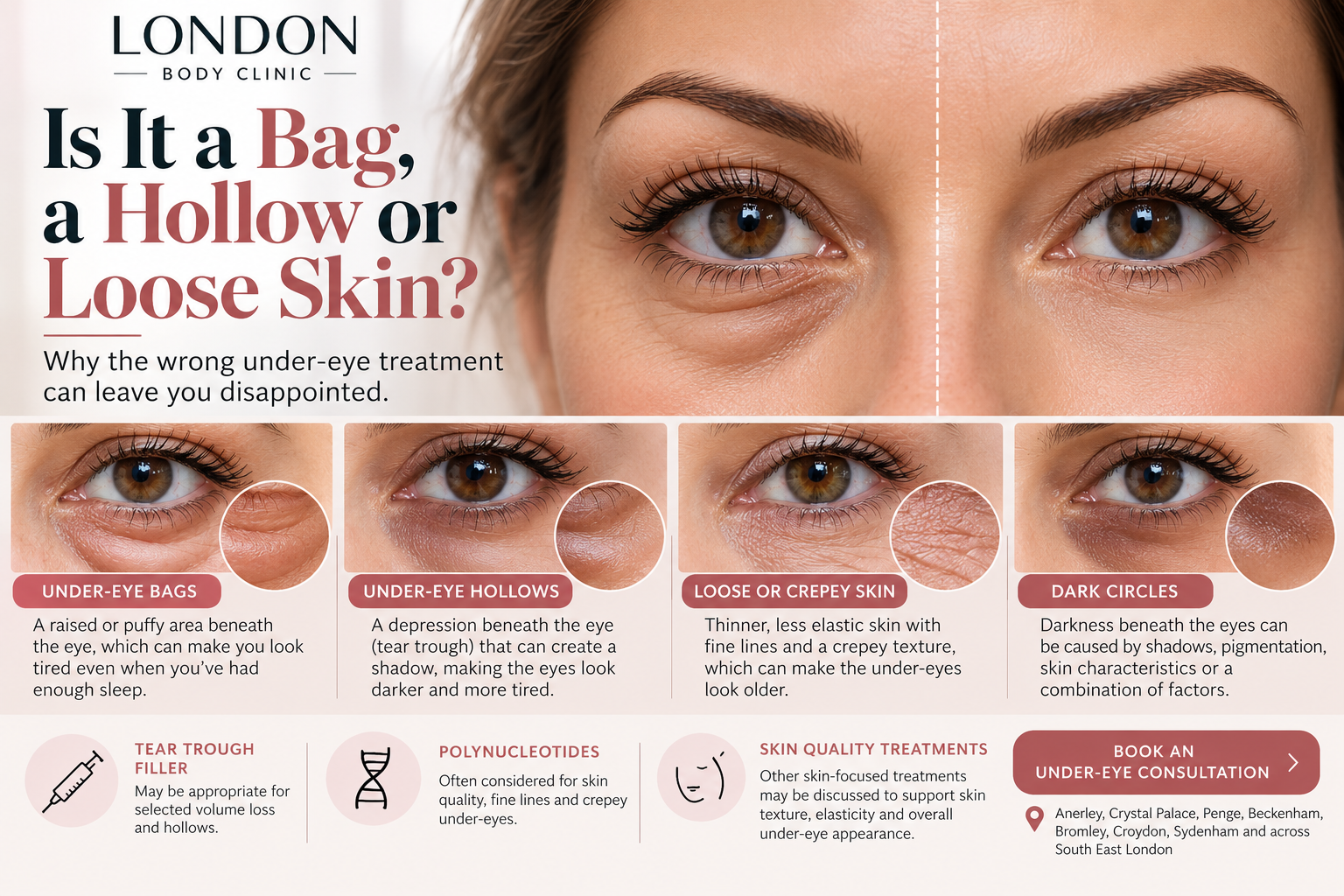
Is It a Bag, a Hollow or Loose Skin? Why the Wrong Under-Eye Treatment Can Leave You Disappointed
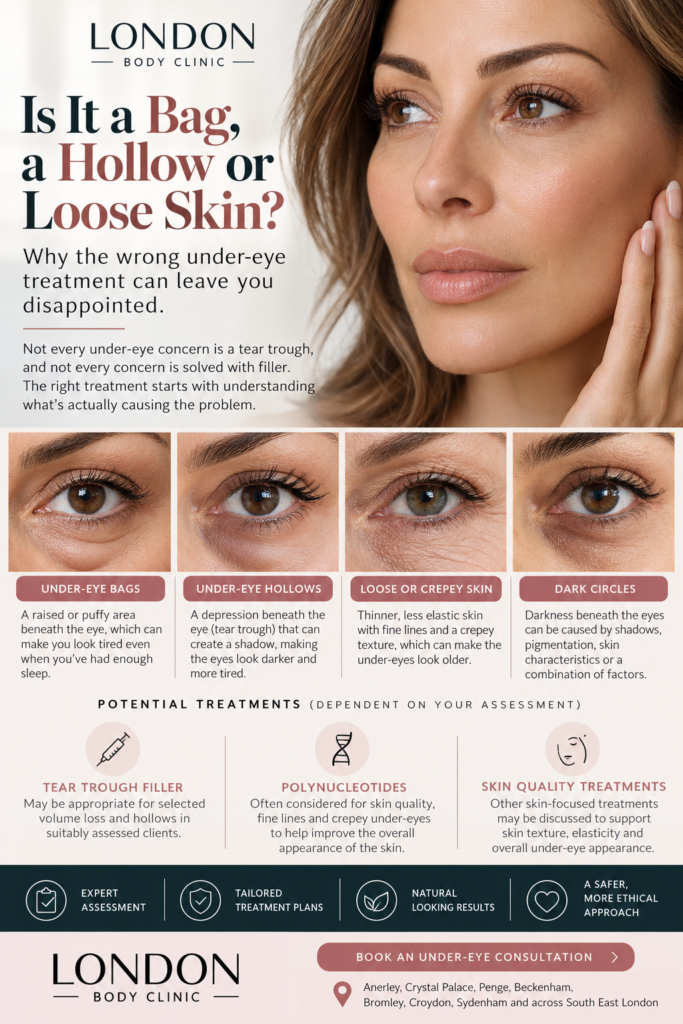
Is It a Bag, a Hollow or Loose Skin? Why the Wrong Under-Eye Treatment Can Leave You Disappointed
The under-eye area is one of the most common concerns we hear about at London Body Clinic.
“I look tired even when I’ve slept.”
“My concealer makes it look worse.”
“I’ve got these shadows under my eyes that never disappear.”
“My under-eyes suddenly look older.”
And increasingly:
“I think I need tear trough filler.”
But here’s the problem: not every under-eye concern is a tear trough.
What looks like a “bag” in the mirror could actually be a hollow creating a shadow. What looks like a hollow could be made more noticeable by puffiness above it. Fine lines may be caused predominantly by declining skin quality rather than volume loss.
And sometimes several of these things are happening at once.
This is why choosing an under-eye treatment in London shouldn’t begin with deciding which treatment you want. It should begin with identifying what is actually creating the appearance you’re unhappy with.
At London Body Clinic, our approach is assessment first, treatment second.
Why the under-eye area is so complicated
The skin around the eyes is delicate, and relatively small changes in volume, skin quality and surrounding structures can dramatically alter how the area looks.
Ageing can also affect several components of the face simultaneously.
Skin can become thinner and less elastic. Facial volume distribution changes. The transition between the lower eyelid and cheek can become more noticeable. Fine lines may develop, while some people experience increasingly visible puffiness.
That means two women can both say:
“I hate my under-eye bags.”
Yet potentially need completely different approaches.
This is also why copying somebody else’s treatment from TikTok or Instagram can be disappointing.
Their anatomy isn’t your anatomy.
Their “before” isn’t your “before.”
And the treatment that transformed their under-eyes may not address the thing creating yours.
Problem 1: Under-eye hollows
A hollow is essentially a depression beneath the eye.
For some people, this creates a visible groove between the lower eyelid and upper cheek. Because of the way light falls across this depression, it can create a shadow that makes the eyes appear darker or more tired.
This is commonly associated with the tear trough.
Some people naturally have more pronounced hollows, while facial ageing and changes in volume can make them more noticeable over time.
When might tear trough filler be considered?
For an appropriately selected client, tear trough filler may be considered where a genuine volume deficit is contributing significantly to the concern.
Hyaluronic acid dermal filler can be strategically placed to soften the transition between the lower eyelid and cheek.
The goal shouldn’t be to create a completely flat under-eye.
Instead, treatment should aim for a subtle improvement that works with the person’s natural facial structure.
However, tear trough filler is not suitable for every under-eye concern.
If the primary issue is loose skin, significant puffiness or another anatomical feature rather than volume loss, adding filler may not address what is actually bothering you.
This is precisely why a proper consultation for tear trough filler in London is so important.
Problem 2: Under-eye bags and puffiness
Here’s where things often get confused.
A hollow and a bag aren’t the same thing.
Someone can also have both.
Under-eye bags can create a raised area beneath the eye, while a hollow immediately below can create a shadow. From certain angles, that shadow can make the bag appear even more prominent.
A client may look at the dark indentation and think:
“I need that filled.”
But simply adding volume isn’t automatically the answer.
Puffiness can have different causes and can fluctuate. That’s why persistent or unexplained swelling should not simply be treated as a cosmetic problem without appropriate assessment.
Where there is significant under-eye bagging, filler may also have limitations. In some cases, a practitioner may advise that filler isn’t the most appropriate option at all.
A good consultation sometimes ends with:
“I don’t think filler is right for you.”
And that’s valuable advice.
Problem 3: Crepey, thin or wrinkled under-eye skin
This is another concern frequently mistaken for volume loss.
You pull the skin slightly and think:
“If we could just fill this out, it would look smoother.”
But filler primarily addresses volume and contour. It isn’t a universal treatment for skin quality.
If your biggest concern is thin, crepey-looking skin, fine lines or deteriorating skin texture, we may instead discuss treatments focused on skin quality.
Polynucleotides under the eyes
Polynucleotides under the eyes have become increasingly popular with people who want to focus on skin quality rather than simply adding volume.
They are injectable skin treatments used with the aim of supporting skin quality, hydration and overall appearance.
This makes them very different from conventional tear trough filler.
Think of the distinction like this:
Tear trough filler → primarily addresses selected volume deficits and contour.
Polynucleotides → primarily used as a regenerative skin-quality treatment.
One isn’t inherently “better” than the other.
They are designed to address different concerns.
For someone searching for a crepey under-eye treatment in London, assessing the quality of the skin itself is therefore extremely important.
Problem 4: Dark circles
“I’ve got dark circles” sounds like one problem.
Unfortunately, it isn’t that simple.
Darkness beneath the eyes can appear for different reasons.
For example, a structural hollow can cast a shadow. Skin characteristics can make underlying structures more visible. Pigmentation can contribute to darkness. Puffiness can create shadows beneath a raised area.
And sometimes several factors coexist.
That’s why no responsible practitioner should promise that one injectable treatment will “remove dark circles.”
We first need to understand why the area looks dark.
If the darkness is predominantly a shadow caused by volume loss, addressing the structural issue may improve its appearance.
If the darkness is predominantly pigmentation, adding filler doesn’t remove pigment.
Again:
Treat the cause, not simply the label.
Problem 5: Loose under-eye skin
Skin around the eyes can gradually lose firmness and elasticity.
This can create:
- fine lines
- wrinkling
- crepey texture
- skin laxity
- makeup settling into lines
- an increasingly tired appearance
A common mistake is trying to solve skin laxity with volume.
They’re different problems.
Depending on the individual, a consultation may therefore explore treatments intended to support skin quality rather than immediately reaching for filler.
The important part is determining whether the concern is predominantly volume, skin quality, laxity, puffiness — or a combination.
What if you have more than one problem?
This is incredibly common.
You might have a small tear trough and crepey skin.
You could have puffiness and a hollow beneath it.
You may have volume loss through the mid-face that’s affecting how the entire under-eye transition appears.
This is where aesthetic treatment becomes much more nuanced than:
“You have a line. Let’s fill the line.”
Sometimes improving the surrounding area can change how the under-eye looks without aggressively treating the tear trough itself.
And sometimes the best plan isn’t one treatment performed in one appointment.
It may involve improving skin quality first, reassessing, and only then deciding whether additional structural correction would genuinely benefit you.
Tear trough filler vs polynucleotides: what’s the difference?
This is probably one of the most useful distinctions to understand.
| Concern | Tear Trough Filler | Polynucleotides |
|---|---|---|
| True volume hollow | May be appropriate | Doesn’t replace lost volume in the same way |
| Crepey skin | Not primarily designed for this | May be considered for skin quality |
| Fine lines/skin quality | Limited role | Often considered |
| Significant eye bags | May not be appropriate | Requires individual assessment |
| Structural contour | Can address selected hollows | Not a conventional contouring filler |
| Treatment choice | Anatomy dependent | Skin-quality dependent |
And sometimes neither is the correct answer.
That is an important part of ethical aesthetic practice.
Why more filler isn’t always better
The under-eye isn’t an area where we believe in chasing perfection with increasing quantities of product.
It requires careful patient selection, conservative treatment and an understanding of the surrounding facial anatomy.
Previous filler is also relevant.
If you’ve already had tear trough filler elsewhere and you’re unhappy with the result, the answer isn’t automatically to inject more on top.
We need to understand:
What was used? When was it injected? Where was it placed? What does the area look and feel like now?
Only then can an appropriate plan be discussed.
“But TikTok says I need tear trough filler…”
Social media can be brilliant for discovering treatments.
It isn’t brilliant at diagnosing your face.
A 20-second transformation doesn’t tell you everything about the client’s anatomy, medical history, previous treatments, product selection, technique or long-term outcome.
And algorithms naturally show dramatic transformations because they’re interesting to watch.
Your treatment plan shouldn’t be decided by an algorithm.
Your anatomy should decide it.
Our approach to under-eye treatment at London Body Clinic
At London Body Clinic, we don’t believe in automatically treating the area a client points to.
We want to understand why it looks the way it does.
During an under-eye consultation we may consider the appearance of the tear trough, skin quality, laxity, puffiness, facial volume distribution, previous aesthetic treatments and the result you’re hoping to achieve.
Sometimes the answer may be tear trough filler.
Sometimes we may discuss polynucleotides or another skin-quality approach.
Sometimes we may recommend treating another area first.
And sometimes the safest and most appropriate answer is not to treat.
For us, that is just as important as knowing how to perform the treatment.
Looking for under-eye treatment in London?
If you’re constantly looking tired despite sleeping well, noticing hollows beneath your eyes, struggling with crepey skin or wondering whether you actually need tear trough filler, start with an assessment rather than choosing the treatment yourself.
London Body Clinic welcomes clients from Anerley, Crystal Palace, Penge, Beckenham, Bromley, Croydon, Sydenham and across South East London.
Book an under-eye consultation with London Body Clinic and let us assess whether you’re dealing with a bag, a hollow, skin quality changes — or a combination of all three.
Frequently Asked Questions
1. What is the best treatment for under-eye hollows?
There isn’t one treatment that’s best for everyone. Where a genuine volume deficit is responsible for the hollow, tear trough filler may be considered for suitable clients. Other people have predominantly skin-quality or puffiness concerns and may require a different approach.
2. What is the difference between under-eye bags and tear troughs?
An under-eye bag is generally a raised or puffy area, whereas a tear trough describes a depression or hollow between the lower eyelid and cheek. It is possible to have both simultaneously.
3. Does tear trough filler get rid of eye bags?
Not necessarily. Tear trough filler primarily addresses selected volume deficits. Someone with significant puffiness or prominent under-eye bags may not be an appropriate candidate for filler.
4. Are polynucleotides better than tear trough filler?
They do different things. Tear trough filler is primarily used to address selected volume loss and contour, whereas polynucleotides are used with the aim of improving skin quality. Which is more appropriate depends on what is actually causing the concern.
5. Can polynucleotides help crepey under-eye skin?
Polynucleotides may be considered where skin quality, fine lines and crepey texture are concerns. Suitability and realistic expectations should be discussed during consultation.
6. Why do my under-eyes look dark even when I sleep well?
Under-eye darkness can have several contributing factors, including shadows from hollows or puffiness, pigmentation and skin characteristics. Identifying the cause is important before selecting a cosmetic treatment.
7. Can tear trough filler make under-eye bags look worse?
Filler isn’t appropriate for every under-eye anatomy. Where puffiness is already present, adding volume may not produce the desired result. This is why careful assessment and patient selection are particularly important around the eyes.
8. What is the best treatment for crepey under-eyes?
It depends on the degree of skin change, anatomy, medical history and desired result. Skin-quality treatments such as polynucleotides may be discussed, while other cases may require a different approach.
9. Am I suitable for tear trough filler?
Suitability can’t be determined from a photograph or social-media trend alone. A practitioner needs to assess your anatomy, medical history, previous treatments and the nature of the concern before recommending tear trough filler.
10. Where can I get an under-eye consultation in South East London?
London Body Clinic is based at 1 The Parade, Croydon Road, Anerley, London SE20 7AA, conveniently located for clients travelling from Crystal Palace, Penge, Beckenham, Bromley, Croydon, Sydenham and surrounding South East London areas.