

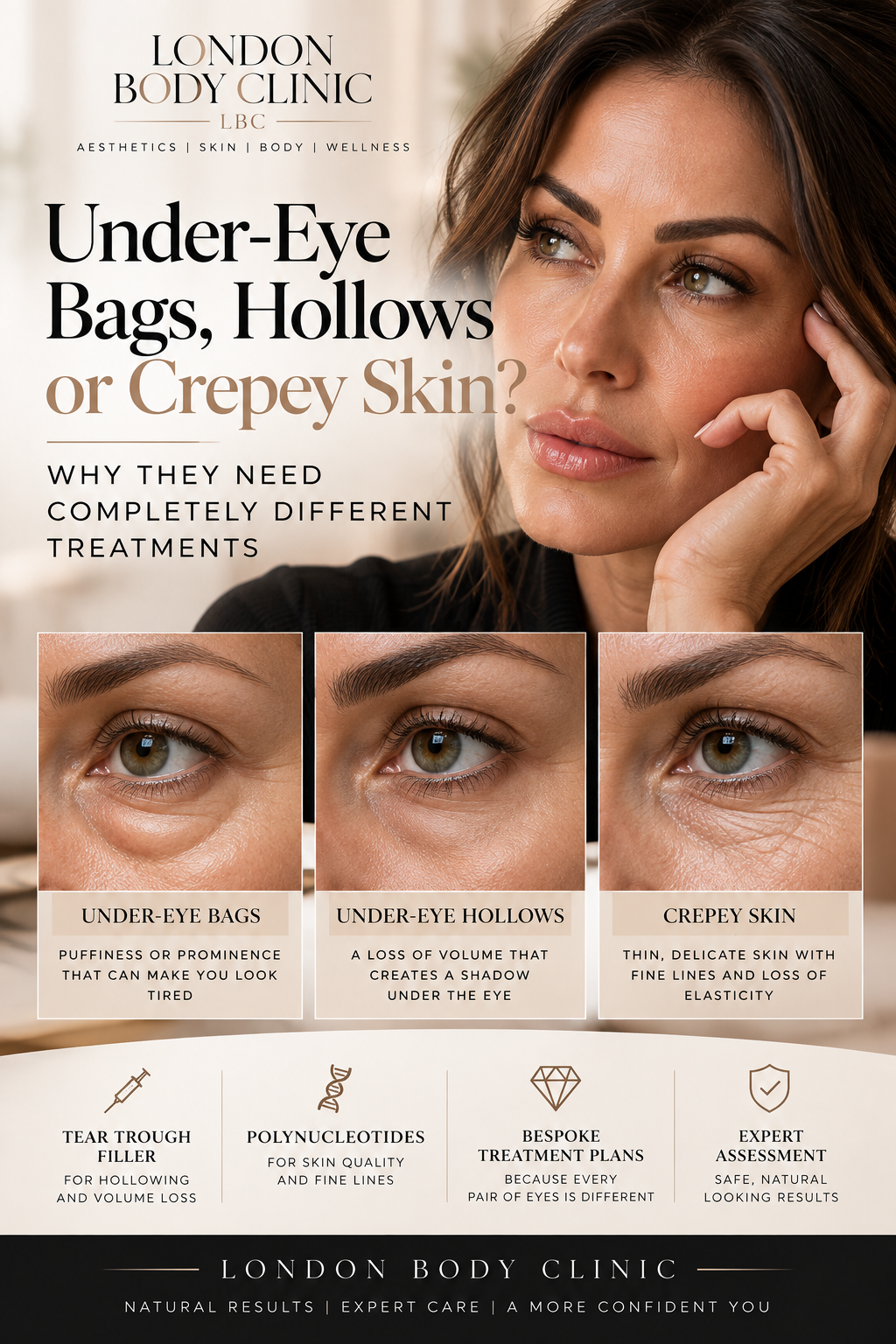
Under-Eye Bags, Hollows or Crepey Skin? Why They Need Completely Different Treatments
Under-Eye Bags, Hollows or Crepey Skin? Why They Need Completely Different Treatments
By London Body Clinic
If you look in the mirror and think, “My under-eyes make me look exhausted,” it can be tempting to assume you simply need an “under-eye treatment.”
But this is one of the most important things we explain during consultations at London Body Clinic:
Not all tired-looking eyes are the same — and they shouldn’t all be treated in the same way.
One person may have a true hollow or tear trough caused by a lack of structural volume. Another may have prominent under-eye bags or puffiness. Someone else may have thin, crepey skin covered in fine lines. And many people have a combination of several concerns.
Treating them all with the same product or procedure can produce disappointing results — and in some cases can make the area look worse.
The under-eye area is anatomically complex. The skin is exceptionally thin, and the region contains important vascular and structural anatomy. This is one reason why careful assessment and patient selection are particularly important before any injectable treatment around the eyes.
So before asking, “What’s the best treatment for my under-eyes?”, there is a much more useful question:
What is actually causing the problem?
Let’s break down the difference between under-eye bags, tear trough hollows and crepey under-eye skin — and the treatment approaches that may be considered for each.
Why Do Our Under-Eyes Change as We Get Older?
The eye area is often one of the first places where people notice facial ageing.
The skin surrounding the eyes is naturally delicate, and changes in skin quality, facial volume and underlying structures can alter how light and shadow fall across the area.
You may begin noticing:
- Fine lines beneath the eyes
- Crepey or thinner-looking skin
- A groove extending from the inner corner of the eye
- Dark shadows
- Puffiness
- More prominent under-eye bags
- Loss of smoothness between the lower eyelid and cheek
- A generally tired appearance
And this is where correct diagnosis matters.
A dark-looking under-eye, for example, isn’t necessarily pigmentation. A hollow can create a shadow that looks dark.
Similarly, somebody asking for tear trough filler may actually have significant under-eye puffiness rather than volume loss.
The treatment should therefore be chosen for the cause, not simply the name the client has given the concern.
1. Under-Eye Hollows and Tear Troughs
A tear trough is the groove running from the inner corner beneath the eye towards the upper cheek.
For some people it is naturally more pronounced; for others it becomes increasingly visible with age-related changes and volume loss.
The hollow creates a transition between the lower eyelid and cheek. Because of the shadow this creates, the person may look tired even when they’ve slept perfectly well.
You might describe it as:
“My eyes look sunken.”
“I’ve developed a line underneath my eyes.”
“I always look tired.”
“There’s a dark shadow under my eye that concealer doesn’t hide.”
When the primary problem is genuinely a structural hollow, hyaluronic-acid tear trough filler may be an option in carefully selected patients.
What Does Tear Trough Filler Do?
Unlike treatments intended to improve skin quality, dermal filler provides volume and structural correction.
A carefully selected hyaluronic-acid filler can be used to reduce the appearance of a hollow and create a smoother transition between the lower eyelid and cheek.
This distinction is crucial.
Recent literature comparing hyaluronic-acid filler with polynucleotides for under-eye rejuvenation describes HA filler as better suited to structural correction and volume loss, whereas polynucleotides are more associated with gradual improvements in skin quality.
In other words:
Hollow = think structure and volume.
But that does not mean everyone with tired-looking eyes needs tear trough filler.
Who May Not Be the Ideal Candidate for Tear Trough Filler?
The under-eye isn’t an area where we believe in injecting simply because somebody asks for filler.
Assessment matters.
If someone has significant puffiness, prominent bags, certain anatomical characteristics or a tendency towards swelling, adding a volume-producing product may not address the actual concern.
Hyaluronic-acid filler in the periorbital region also has recognised potential complications, including oedema and contour irregularities, which is another reason careful patient selection is essential. PubMed Central (PMC)
Sometimes the most responsible answer during a consultation is:
“Filler isn’t the right treatment for you.”
At London Body Clinic, we would much rather recommend no filler than place filler into an area where we don’t believe it will produce an appropriate result.
2. Under-Eye Bags and Puffiness
This is where things become very different.
An under-eye hollow is essentially a depression.
An under-eye bag is a prominence or puffiness.
They are not interchangeable problems.
Temporary puffiness can also be related to fluid accumulation in the tissues surrounding the eyes, and factors such as allergies can contribute. Cleveland Clinic
For some people, however, the appearance is more persistent and relates to their anatomy and age-related changes around the eye.
Clients will often come to us saying:
“I want tear trough filler for my eye bags.”
But if the primary concern is already a protruding bag, simply adding volume underneath it isn’t automatically the answer.
Why Correct Assessment Matters
Imagine looking at the face from the side.
If there is a hollow beneath a prominent bag, carefully selected treatment of the surrounding contour may sometimes change the way the area appears.
But if the principal problem is the bag itself, the treatment plan may need to be completely different.
And there are situations where aesthetic injectable treatments simply aren’t the appropriate solution.
Significant structural under-eye bags may warrant discussion with an appropriately qualified medical or surgical specialist rather than repeatedly trying non-surgical treatments.
Good aesthetics isn’t about finding a way to inject everybody.
It’s knowing when not to.
3. Crepey Under-Eye Skin and Fine Lines
Now we have an entirely different problem again.
Perhaps you don’t have particularly deep hollows.
You don’t have significant bags.
But when you smile — or sometimes even when your face is resting — the skin underneath your eyes looks thin, lined, crinkled or crepey.
Clients often describe this as:
“My under-eye skin suddenly looks old.”
“My concealer sits in every line.”
“The skin looks really thin.”
“I don’t need volume — I just want the skin to look better.”
This is where skin quality becomes the focus.
And it’s one of the reasons polynucleotides for under-eyes have generated so much interest in aesthetic medicine.
Polynucleotides for Under-Eyes: What Do They Actually Do?
Polynucleotides are injectable products used in regenerative aesthetics with the aim of improving aspects of skin quality rather than creating the type of structural volume associated with conventional dermal filler.
Current research suggests potential improvements in areas including skin texture, elasticity, hydration and wrinkles, although the evidence base is still developing and researchers have called for larger, higher-quality studies and more standardised treatment protocols. PubMed Central (PMC)
This is an important distinction because polynucleotides are sometimes marketed online as though they are a miracle solution for every under-eye concern.
They’re not.
For someone whose principal problem is a significant structural hollow, polynucleotides aren’t going to behave like tear trough filler and simply replace lost volume.
However, when the concern is thin, crepey skin, fine lines or declining skin quality, polynucleotides may be considered as part of an individual treatment plan.
Recent evidence specifically examining the periocular area suggests PN treatments may be particularly relevant where dermal thinning, crepiness and fine lines are the concern, whereas HA filler remains more appropriate for structural volume deficiency. PubMed Central (PMC)
That’s why asking:
“Is filler or polynucleotide better?”
isn’t really the right question.
Better for what?
That’s the question that matters.
Tear Trough Filler vs Polynucleotides for Under-Eyes
Here’s the simplest way to understand the difference.
Tear Trough Filler
Primarily considered when there is an appropriate structural hollow or volume deficit.
The aim is generally to improve contour and soften the visible depression between the lower eyelid and cheek.
Polynucleotides
More focused on skin quality than significant volumisation.
They may be considered where concerns include thinness, crepiness, texture, elasticity and fine lines.
Under-Eye Bags
Neither should automatically be assumed to be the solution.
The cause and anatomy of the bag need to be assessed first.
And sometimes a client has all three.
That’s where a personalised treatment plan becomes particularly important.
Can You Have Both Tear Trough Filler and Polynucleotides?
Potentially, yes — where clinically appropriate.
A client may have a genuine tear trough hollow and poor-quality, crepey skin.
One treatment is addressing structure.
The other is addressing skin quality.
Current literature supports this concept of individualised or multimodal under-eye rejuvenation rather than viewing HA filler and polynucleotides as simple substitutes for one another. PubMed Central (PMC)
But this doesn’t mean everybody needs both.
At London Body Clinic, our approach is not:
“How many treatments can we add?”
It is:
“What are we actually trying to correct?”
Only then should treatment options be discussed.
What About Dark Circles Under the Eyes?
Dark circles deserve a category of their own because they can have different causes.
What looks like pigmentation may actually be shadowing from a hollow.
Thin skin can make underlying vascular colour more visible.
Puffiness can alter light reflection.
And some people have genuine pigmentation.
This is why seeing a photograph online and deciding, “I need tear trough filler,” can be misleading.
If the darkness is largely caused by shadow from a hollow, correcting an appropriate structural deficit may improve the shadow.
But filler isn’t a treatment for every type of pigmentation or every dark circle.
Likewise, emerging evidence has explored polynucleotides in the context of infra-orbital dark circles and periocular skin quality, but the wider PN evidence base remains limited and evolving. PubMed Central (PMC)
Why We Don’t Believe in One-Size-Fits-All Under-Eye Treatments
Social media has made aesthetics incredibly accessible.
That’s positive in many ways.
But it has also encouraged people to diagnose themselves by treatment name.
Someone sees a tear trough transformation and thinks:
“That’s what I need.”
Someone sees a polynucleotide video and thinks:
“That’s better than filler.”
Someone else sees “under-eye rejuvenation” and assumes one treatment can fix everything.
At London Body Clinic, we believe the consultation should come before the treatment choice.
We want to know:
What bothers you?
Is it a hollow?
A shadow?
Pigmentation?
Skin quality?
Fine lines?
Puffiness?
A prominent bag?
Or several concerns occurring together?
We then look at the anatomy, your medical history, suitability, expectations and what can realistically be achieved.
Because sometimes the best result comes from choosing a different treatment.
And sometimes it comes from not treating at all.
Under-Eye Treatment in London at London Body Clinic
If you’re researching under-eye treatment in London and aren’t sure whether you need tear trough filler, polynucleotides for under-eyes or another approach, you don’t need to diagnose yourself before coming to see us.
That’s our job.
Our approach at London Body Clinic is based around creating natural-looking results and choosing treatment according to the individual rather than following trends.
We’ll assess what is actually creating the concern and discuss suitable options, expected outcomes and limitations before treatment.
Your under-eyes don’t need the treatment that’s trending. They need the treatment that’s appropriate for them.
Book an under-eye consultation with London Body Clinic to discuss your concerns and discover which approach may be suitable for you.
Frequently Asked Questions About Under-Eye Treatments
What is the best treatment for under-eye hollows?
There isn’t one treatment suitable for everyone. Where a true tear trough hollow is caused by an appropriate structural volume deficit, hyaluronic-acid filler may be considered following assessment. Other clients may require a different approach depending on their anatomy and concerns.
Is tear trough filler good for under-eye bags?
Not necessarily. A bag and a hollow are different anatomical concerns. Adding filler where puffiness or prominent bags are the main issue may not address the cause and can be unsuitable for some patients. An in-person assessment is important before deciding on treatment.
Are polynucleotides good for crepey under-eye skin?
Current research suggests polynucleotides have potential for improving skin texture, elasticity and fine wrinkles, including around the eyes. However, research is still developing, and results and suitability vary between individuals. PubMed Central (PMC)
Are polynucleotides better than tear trough filler?
They perform different roles. Tear trough filler primarily provides structural/volumetric correction, while polynucleotides are used with the aim of improving skin quality. One isn’t universally “better” than the other. The appropriate option depends on what is causing the under-eye concern. PubMed Central (PMC)
Can polynucleotides fill an under-eye hollow?
Polynucleotides aren’t intended to provide the same degree of immediate structural volume correction as hyaluronic-acid tear trough filler. Where significant volume loss is the primary concern, PN treatment alone may provide limited correction of the hollow. PubMed Central (PMC)
Can I have polynucleotides and tear trough filler together?
In selected patients, different treatment modalities may form part of a combined plan because one can address structural volume while another targets skin quality. Whether this is appropriate should be determined after consultation and assessment.
Why do my under-eyes suddenly look older?
Age-related changes can affect skin quality, elasticity, soft tissues and facial contours around the eye. Lifestyle, sun exposure and individual anatomy can also influence appearance. The underlying cause needs to be identified before choosing a treatment.
Can under-eye treatment get rid of dark circles?
It depends on why the area looks dark. Shadowing caused by a hollow is different from pigmentation or visible vascular colour beneath thin skin. No single injectable treatment corrects every cause of dark circles.
How do I know which under-eye treatment I need?
Start with a consultation rather than choosing a treatment from social media. A practitioner should assess whether the primary concern is volume loss, skin quality, puffiness, pigmentation, structural bags or a combination before recommending an appropriate treatment plan.
Where can I get under-eye treatment in London?
London Body Clinic offers consultations for clients concerned about under-eye ageing, hollows and skin quality. Following assessment, suitable treatment options can be discussed based on your anatomy, medical history and desired outcome.