

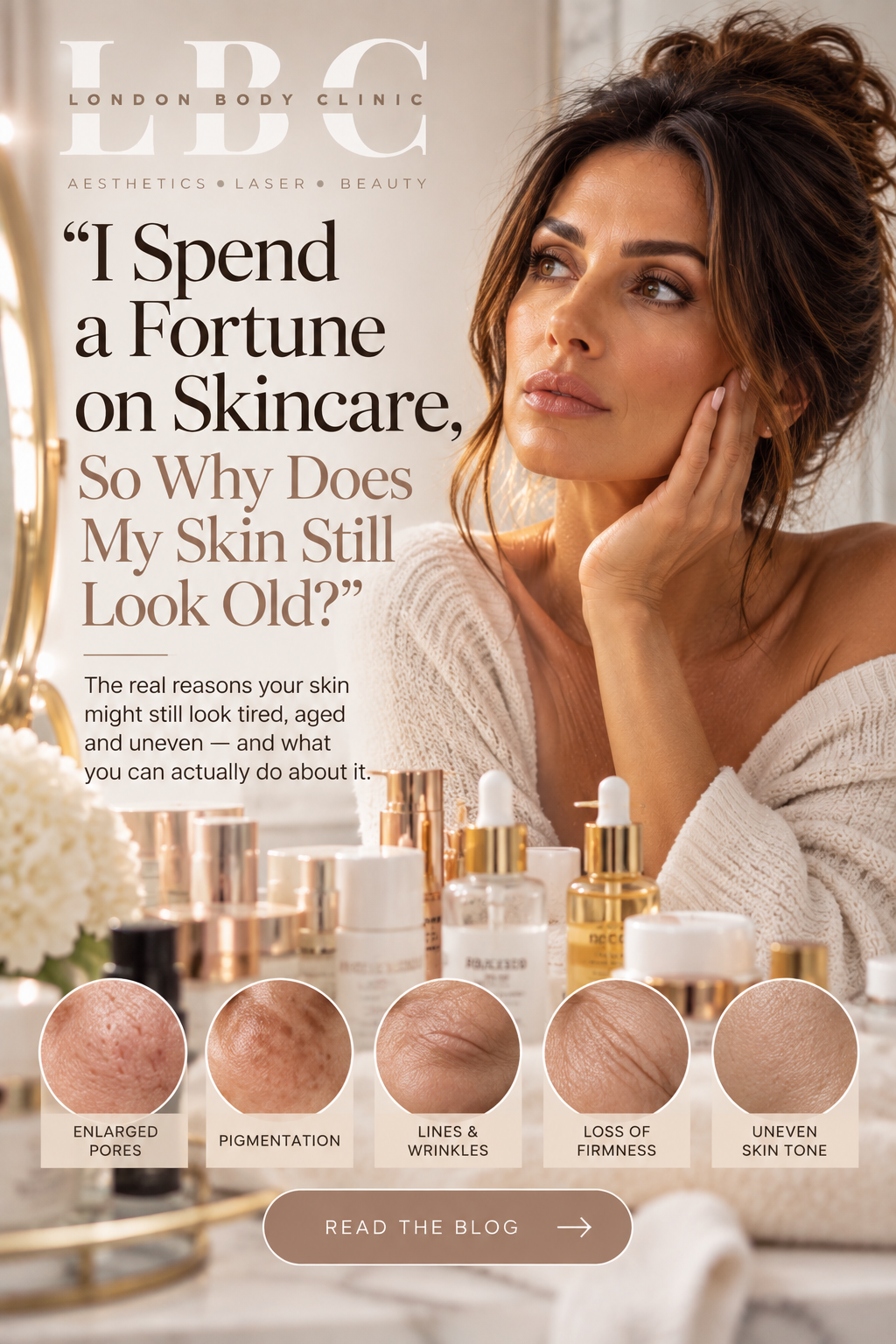
I Spend a Fortune on Skincare, So Why Does My Skin Still Look Old?
I Spend a Fortune on Skincare, So Why Does My Skin Still Look Old?
By London Body Clinic | Aesthetics • Laser • Beauty
Your bathroom cabinet looks like the skincare department of a luxury store.
You have the cleanser. The vitamin C. The retinol. The hyaluronic acid. The eye cream that promised to change your life. The moisturiser that cost far more than you intended to spend. And, of course, the SPF.
You use them religiously.
So why, when you look in the mirror, are you still seeing enlarged pores, pigmentation, fine lines, uneven skin texture, loss of firmness and skin that simply doesn’t look as fresh as it used to?
For many women in their late 30s, 40s and 50s, this is incredibly frustrating.
And it can lead to buying yet another product.
But here’s the important part:
Your skincare might not be failing. You may simply be asking it to do something it cannot realistically do on its own.
At London Body Clinic, we regularly meet women who have invested heavily in skincare but still feel unhappy with their skin.
So, let’s talk about what’s actually happening to ageing skin, why expensive skincare isn’t always enough, and the professional skin rejuvenation treatments that may be considered when creams and serums have reached their limitations.
Why Does My Skin Still Look Old When I Use Good Skincare?
Because skin ageing is far more complex than having dry skin or a few wrinkles.
As we age, changes occur within the skin and the structures beneath it.
Collagen and elastin – important proteins involved in the skin’s structure and elasticity – change with age. Cumulative sun exposure can contribute to pigmentation, lines and changes in texture. Cell turnover and hydration can also change.
Meanwhile, the deeper structures of the face change too.
So when you look in the mirror and think:
“My skin just doesn’t look like it used to.”
you may actually be seeing several different concerns simultaneously.
And one moisturiser – regardless of its price – isn’t designed to address all of them.
1. Your Skin Is Losing Collagen
One of the major differences between younger and more mature-looking skin is its underlying support.
Collagen contributes to skin structure and firmness.
As age-related changes occur, you may begin noticing:
- Fine lines
- Wrinkles
- Less firmness
- Crepey texture
- Enlarged-looking pores
- Changes in elasticity
- A less smooth appearance
This is where the difference between skincare and professional skin rejuvenation treatments becomes important.
Topical skincare can be an extremely valuable part of maintaining healthy-looking skin, but certain clinic-based treatments are designed to work differently and at different depths.
For suitable clients, treatments such as RF microneedling with Morpheus8 may be considered when concerns include skin texture, pores and laxity.
2. Pigmentation Can Make Skin Look Older Than Lines Do
When people think about ageing, they immediately think about wrinkles.
But uneven pigmentation can have an enormous effect on how old or tired skin appears.
Sun exposure accumulated over many years may contribute to areas of pigmentation and uneven tone becoming more apparent later.
This is why someone can have relatively few deep wrinkles but still feel that their complexion looks older.
The first step shouldn’t be blindly booking whichever pigmentation treatment you’ve seen online.
Different types of pigmentation can require different approaches, and some treatments aren’t appropriate for every skin type or every pigmentation concern.
A proper skin consultation matters.
And whatever else you do, sun protection remains fundamental.
3. Enlarged Pores Aren’t Simply a Cleansing Problem
If you’ve bought product after product promising to “close your pores”, you’re definitely not alone.
Pores don’t literally open and close like doors.
Their visibility can be influenced by several factors, including oil production, congestion, skin texture and changes in the structural support surrounding them.
This is why simply cleansing more aggressively isn’t necessarily the answer.
In fact, repeatedly stripping or irritating your skin can create other problems.
When enlarged pores form part of a wider concern involving skin texture and ageing, professional treatments such as microneedling or RF microneedling may sometimes be considered following assessment.
The objective isn’t to create completely poreless skin – because real human skin has pores.
It’s about improving overall skin quality where possible.
4. Your Skin Might Be Hydrated – But Still Lack Firmness
This is an important distinction.
Hydration and laxity aren’t the same thing.
You can have beautifully moisturised skin and still notice that it isn’t as firm as it used to be.
A hydrating serum can help the surface of your skin feel more comfortable and appear temporarily plumper, but it doesn’t mean it can significantly tighten lax skin.
This is where women often become frustrated.
They keep buying increasingly expensive moisturisers because they are trying to solve loss of firmness as though it were simply dryness.
Depending on the individual concern, professional options might include treatments designed around skin quality, hydration, remodelling or tightening.
But the correct treatment depends on what’s actually happening to your skin.
5. You May Be Treating the Wrong Problem
This is perhaps the biggest reason people spend a fortune on skincare without getting the result they want.
You can’t effectively address a concern until you understand what it is.
Take the statement:
“I look tired.”
That could mean pigmentation.
It could mean dehydrated skin.
It could mean under-eye hollows.
It could mean crepey skin.
It could involve facial volume changes.
Or it could simply mean you actually are tired!
Likewise:
“My face looks old.”
isn’t a diagnosis.
This is why we believe a good aesthetics consultation should begin with:
“What is it that you’re actually noticing?”
Not:
“Which treatment would you like?”
6. Your £150 Cream and a Clinic Treatment Don’t Do the Same Job
This doesn’t mean expensive skincare is pointless.
Far from it.
A well-chosen skincare routine can be valuable for maintaining skin condition, supporting hydration, addressing certain concerns and protecting the skin from further environmental damage.
But there are limits to what topical products can reasonably achieve.
If significant laxity is your concern, another moisturiser may not produce the change you’re hoping for.
If you’re concerned about deeper structural ageing, skincare alone may not address everything you’re seeing.
Equally, clinic treatments aren’t a replacement for looking after your skin every day.
Think of the two as potentially complementary rather than competing.
Good skincare supports your skin every day. Professional treatments can target selected concerns in ways your daily routine cannot.
So What Professional Treatments Can Improve Ageing Skin?
There is no single “best anti-ageing treatment” for everybody.
At London Body Clinic, treatment recommendations depend on the client’s skin, medical history, concern, suitability and desired outcome.
Some options that may be considered include:
Morpheus8 RF Microneedling
Morpheus8 combines microneedling with radiofrequency energy.
For suitable clients, it may be considered for concerns involving skin texture, enlarged pores, fine lines and skin laxity.
Morpheus8 isn’t simply a facial.
It works differently from surface skincare and is generally undertaken as a course when clinically appropriate.
If you’ve been searching for Morpheus8 in London because your main concerns are texture, pores or laxity, a consultation should establish whether RF microneedling is actually suitable for your skin.
Skin Boosters
If your skin feels dull, dehydrated or lacking in quality, skin boosters may be another option discussed during consultation.
Skin boosters shouldn’t be confused with traditional dermal filler.
While individual products differ, skin boosters are generally used with the aim of improving aspects of skin hydration and skin quality, rather than dramatically changing facial shape.
For the woman who says:
“I don’t want to look different. I just want my skin to look better.”
this may be an avenue worth discussing with a qualified practitioner.
Microneedling and Skin Rejuvenation
Professional microneedling creates controlled micro-injuries in the skin as part of a skin-remodelling process.
It may be used for various skin-quality concerns depending on the device, protocol and individual.
Again, more isn’t automatically better.
Appropriate treatment depth, frequency, skin assessment and aftercare matter.
HIFU
Where skin laxity is a primary concern, HIFU (High-Intensity Focused Ultrasound) may sometimes be considered in suitable clients.
HIFU and Morpheus8 aren’t interchangeable treatments, however.
One isn’t automatically “better” than the other.
They use different technologies and may be selected for different reasons.
This is exactly why we recommend an individual assessment rather than choosing a treatment based solely on a social-media before-and-after photograph.
What About Botox and Dermal Filler?
This is where aesthetics can become confusing.
You dislike your skin, so someone tells you to have Botox.
Someone else tells you to have filler.
Someone else says Morpheus8.
Then TikTok tells you that you need polynucleotides.
These treatments aren’t all designed to do the same thing.
Botulinum toxin treatments can be used for particular dynamic lines and other indications in appropriate clients.
Dermal fillers can be used for selected volume and structural concerns.
Skin boosters focus more on skin-quality indications.
RF microneedling addresses different aspects of skin remodelling.
So if your concern is primarily enlarged pores and texture, simply adding facial volume may not address what is bothering you.
This is why treating the problem rather than the trend matters.
Why Skin Changes Can Feel So Sudden in Your 40s
We hear this all the time:
“I swear I aged overnight.”
You probably didn’t.
Ageing occurs gradually, but there can be periods where the cumulative changes suddenly become more noticeable.
For women, midlife can also bring hormonal changes that affect the skin. The British Association of Dermatologists notes that menopause-related hormonal changes can affect skin, including dryness and loss of elasticity.
That doesn’t mean every skin concern in your 40s is caused by hormones.
But it does mean that the skincare routine that felt perfect at 32 may not necessarily meet all of your needs at 45.
Stop Trying to Erase Every Sign of Ageing
There is another conversation we need to have.
Skin is supposed to have texture.
It’s supposed to move.
It’s supposed to have pores.
And eventually, it will have lines.
Social media has distorted our perception of what normal skin looks like. Filters, editing, strategic lighting and makeup can create skin that simply doesn’t exist in real life.
At London Body Clinic, the goal isn’t to turn a 48-year-old woman into a digitally filtered 22-year-old.
It’s to look at what genuinely bothers her and discuss realistic options.
You don’t need completely poreless skin.
You don’t need every line removed.
And you certainly don’t need every treatment on the menu.
“I Don’t Want to Look Done. I Just Want Better Skin.”
This is probably one of the most common things women tell us.
And we understand it.
Many of our clients aren’t chasing an entirely different face.
They want to look fresher.
They want their makeup to sit better.
They want improved skin texture.
They want to feel comfortable without foundation.
They want somebody to say:
“Your skin looks amazing.”
Not:
“What have you had done?”
That distinction matters.
Before You Buy Another £100 Serum…
Stop.
Look at your skin and ask yourself:
What am I actually trying to improve?
Is it:
Texture?
Pigmentation?
Pores?
Fine lines?
Laxity?
Hydration?
Facial volume?
Under-eye ageing?
A combination?
Because the answer to “Why does my skin still look old?” isn’t necessarily another bottle.
It might be better skincare.
It might be a professional treatment.
It might be a combination.
And sometimes, it might simply be accepting that normal skin changes with age while choosing to improve the specific things that genuinely bother you.
The important thing is knowing the difference.
Skin Rejuvenation at London Body Clinic
At London Body Clinic, we offer consultations for clients who want to understand their skin rather than simply being sold the latest trending treatment.
Depending on your concern and suitability, your treatment plan may include options such as Morpheus8 RF microneedling, HIFU, skin boosters, microneedling or other aesthetic skin treatments.
Our approach starts with the individual.
Because your skin doesn’t need every treatment. It needs the right treatment for the right concern.
If you’re spending more and more on skincare but still feel frustrated when you look in the mirror, book a consultation with London Body Clinic and let’s start by working out what your skin actually needs.
Frequently Asked Questions
1. Why does my skin still look old even though I use expensive skincare?
Skin ageing involves more than surface hydration. Changes in collagen, elasticity, pigmentation, facial structure and cumulative sun exposure can all influence appearance. Topical skincare can be valuable, but it cannot necessarily address every aspect of facial ageing.
2. What is the best skin treatment for women over 40?
There isn’t one best treatment for everybody over 40. Treatment should depend on the concern. Options may include RF microneedling, skin boosters, microneedling, HIFU or other treatments following an individual consultation.
3. Can Morpheus8 improve ageing skin?
Morpheus8 combines radiofrequency energy with microneedling and may be considered for concerns including skin texture, pores, fine lines and laxity in suitable clients. Results and suitability vary, and a course may be recommended.
4. What is the best treatment for enlarged pores?
The appearance of pores can be influenced by several factors. Depending on the cause and skin type, professional skincare, microneedling or RF microneedling may be considered. Completely eliminating visible pores isn’t a realistic goal.
5. Are skin boosters better than moisturiser?
They perform different roles. Moisturisers are topical skincare products that help support the skin barrier and hydration. Injectable skin boosters are professional treatments used for particular skin-quality indications. One shouldn’t simply be viewed as a stronger version of the other.
6. Can aesthetic treatments improve skin without making me look fake?
Skin-focused treatments can be selected specifically because the client’s goal is improving skin quality rather than dramatically changing facial shape. The appropriate approach depends on your concern, anatomy and treatment suitability.
7. What’s the difference between Morpheus8 and HIFU?
Morpheus8 combines microneedling and radiofrequency, while HIFU uses focused ultrasound energy. They work differently and may be considered for different indications. A consultation can determine whether either treatment is appropriate.
8. Why has my skin suddenly changed in my 40s?
Skin naturally changes with age, while cumulative sun exposure, lifestyle, genetics and hormonal changes can also influence its appearance. For women approaching or experiencing menopause, hormonal changes can contribute to changes such as dryness and reduced elasticity.
9. Can skincare tighten loose skin?
Skincare can support skin health and improve the appearance of certain concerns, but topical products have limitations. If significant laxity is the primary concern, professional treatment options may be worth discussing, although non-surgical procedures also have limitations and cannot replicate surgical lifting.
10. Where can I get skin rejuvenation treatment in London?
London Body Clinic provides consultations for clients concerned about ageing skin, enlarged pores, texture, fine lines, pigmentation and laxity. Following assessment, suitable professional skin-rejuvenation options can be discussed.