
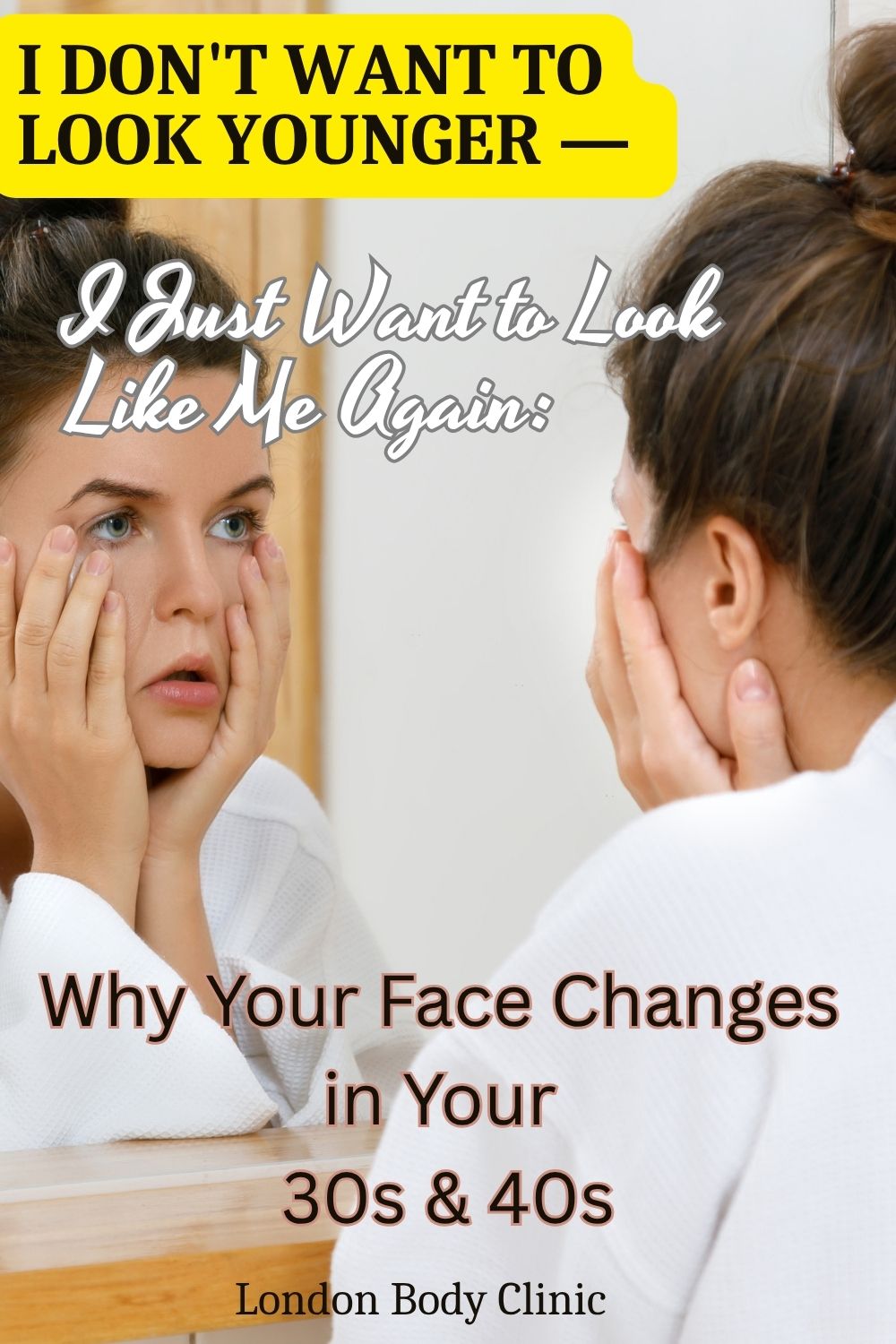
I Don’t Want to Look Younger — I Just Want to Look Like Me Again: Why Your Face Changes in Your 30s and 40s
I Don’t Want to Look Younger — I Just Want to Look Like Me Again: Why Your Face Changes in Your 30s and 40s
“I don’t want to look 20 again. I just want to look like me.”
If you’re a woman somewhere between 35 and 50, there is a good chance you’ll understand exactly what that sentence means.
You look in the mirror one morning and something feels different.
Not dramatically different.
Just… different.
Your jawline isn’t quite as sharp.
Your lower face looks heavier.
There’s a little softness underneath your chin that wasn’t there before.
Your eyes look tired even though you’ve slept.
Your cheeks don’t seem to sit where they used to.
Makeup settles differently.
And the skin on your face and neck somehow doesn’t feel as firm as it once did.
Then come the photographs.
Someone takes a picture of you from an angle you weren’t expecting and you think:
“Is that really what I look like now?”
Here’s the important part.
You don’t necessarily want a different face.
You don’t want huge lips.
You don’t want frozen features.
You don’t want everyone asking what you’ve had done.
And you certainly don’t want to look like you’re desperately trying to be 25.
You simply want the outside to look a little more like the woman you still feel like on the inside.
At London Body Clinic, this is one of the most common conversations we have with women in their 30s, 40s and 50s.
So why does it happen?
And more importantly, what can you actually do about it?
Why Does Your Face Suddenly Start Looking Older in Your 40s?
Facial ageing doesn’t happen overnight, even though sometimes it genuinely feels as though it has.
Ageing involves changes across multiple layers of the face.
Skin changes.
Collagen changes.
Fat distribution changes.
Muscle activity changes.
And deeper structural changes occur too.
This is why treating facial ageing isn’t as simple as putting filler into every line.
In fact, sometimes adding more volume is the last thing a face needs.
The first step is understanding why your face looks different.
“Where Has My Jawline Gone?”
This has to be one of the biggest concerns we hear from women over 35.
You used to have a relatively defined transition between your face and neck.
Then gradually everything starts looking softer.
You notice the beginnings of jowls.
The lower face appears heavier.
You start lifting the skin beside your ears in the mirror to see what you’d look like if everything were slightly tighter.
Sound familiar?
You’re definitely not the only one.
Changes in skin elasticity, collagen, facial volume and underlying structures can all contribute to changes in facial contours as we age.
This is why we don’t believe every disappearing jawline automatically needs jaw filler.
Sometimes the concern is volume.
Sometimes it’s skin laxity.
Sometimes it’s muscular.
Sometimes it’s a combination.
The treatment needs to match the problem.
Depending on suitability, treatments that may form part of a facial rejuvenation plan can include HIFU, RF microneedling treatments such as Morpheus8, skin boosters or carefully selected injectable treatments.
The answer isn’t automatically “more filler”.
“Why Do I Look Tired When I’m Not Tired?”
Another incredibly common complaint.
You feel perfectly fine.
Everyone else apparently thinks you need a nap.
The eye area is one of the first places many people notice visible ageing because the skin around the eyes is delicate.
You might notice:
fine lines
crepey-looking skin
hollowness
dark shadows
under-eye bags
changes in skin texture
heavier-looking upper eyelids
And here’s where treatment planning becomes particularly important.
Not every under-eye concern needs filler.
Sometimes adding filler to an unsuitable under-eye can make the area appear heavier rather than fresher.
Depending on what is actually causing the concern, options might include skin boosters, polynucleotide treatments, RF microneedling, plasma fibroblast or, for suitable candidates, carefully considered tear-trough filler.
A proper consultation matters because two women can both say:
“I hate my under-eyes.”
…and require completely different approaches.
“My Face Is Starting to Look Heavy”
This can be particularly frustrating.
You haven’t necessarily gained weight.
But the lower face appears heavier than it did five years ago.
The corners of your mouth may look different.
You might notice folds around the mouth becoming more visible.
Your jawline becomes softer.
And suddenly the face you remember as relatively V-shaped or defined appears squarer or heavier.
This is where chasing individual lines can become a mistake.
A line isn’t always the problem.
Sometimes it’s simply the place where wider facial changes have become visible.
At London Body Clinic, we prefer to assess the whole face.
Because treating one line without understanding why it developed can create an unnatural result.
“My Neck Is Ageing Faster Than My Face”
You moisturised your face.
You wore SPF on your face.
You invested in skincare for your face.
Your neck?
Perhaps not quite so much.
Then somewhere around your late 30s or 40s you suddenly notice it.
Fine lines.
Crepey skin.
Skin laxity.
Changes underneath the chin.
The neck can become one of those areas women suddenly feel incredibly conscious of.
And unfortunately, skincare alone has limitations once more significant laxity has developed.
Depending on the individual, treatments such as HIFU, RF microneedling/Morpheus8, skin boosters and other collagen-focused approaches may be considered.
Again, there isn’t one “best treatment for an ageing neck”.
There is only the treatment that is most appropriate for your anatomy, skin and expectations.
Why Collagen Matters So Much After 30
Collagen is one of the proteins that helps give skin its structure and firmness.
As we age, collagen production and organisation change.
This contributes to some of the things we associate with ageing skin:
Fine lines.
Changes in firmness.
Reduced elasticity.
Different texture.
This is why modern aesthetics has increasingly moved beyond simply filling things.
For many women in their 30s and 40s, the conversation is now:
How can we improve the quality of the skin itself?
That can mean considering treatments designed around hydration, skin quality or collagen stimulation rather than simply adding volume.
What Is HIFU and Could It Help Sagging Skin?
HIFU stands for High-Intensity Focused Ultrasound.
It uses focused ultrasound energy at targeted depths and is commonly used within aesthetic practice for non-surgical skin tightening and facial contouring treatments.
HIFU may be considered for suitable clients concerned about areas such as:
jawline
lower face
under the chin
neck
general facial laxity
It is particularly attractive to clients who tell us:
“I want something for the sagging, but I don’t want filler.”
However, HIFU isn’t suitable for everybody.
This is why consultation and assessment are essential.
What About Morpheus8 and RF Microneedling?
RF microneedling combines microneedling with radiofrequency energy.
Morpheus8 is one well-known RF microneedling technology used within aesthetic practice.
It may be considered when concerns include skin texture, laxity and overall skin rejuvenation.
For the right client, treatments focusing on collagen and skin quality can make more sense than simply adding volume.
This is particularly relevant after significant weight loss, when clients sometimes find that losing the weight they desperately wanted to lose leaves them with a completely unexpected concern:
looser-looking facial skin.
“I’ve Lost Weight and Now My Face Looks Older”
This is becoming an increasingly common conversation.
You’ve worked incredibly hard to lose weight.
Your clothes fit better.
You feel healthier or more confident in your body.
But then you look at your face.
It looks slimmer — but perhaps also more hollow or less supported.
Weight loss can alter facial volume and make existing skin laxity more noticeable in some people.
That does not mean you automatically need large amounts of filler.
The correct approach depends on what has changed.
For one client, skin quality may be the priority.
For another, laxity.
For another, volume loss.
And for many, it is a combination.
This is exactly why we believe consultation should come before treatment.
Do Skin Boosters Actually Help Ageing Skin?
Skin boosters have become extremely popular with clients who want improvement without dramatically altering their facial features.
Rather than being used primarily to create projection or reshape features in the way dermal fillers can be, skin boosters are generally chosen with skin quality and hydration in mind.
They can be particularly appealing if your complaint is:
“My skin just looks tired.”
Rather than:
“I want to change the shape of my face.”
There are multiple products and treatment approaches available, which is why product choice should be based on the individual rather than whatever happens to be trending online.
Do You Actually Need Botox?
Botulinum toxin can be extremely useful for suitable clients concerned about certain dynamic lines caused by muscle movement.
But Botox doesn’t “fix ageing”.
And it doesn’t tighten every area of loose skin.
If your primary concern is jowling or skin laxity, simply adding more toxin may not address what is actually bothering you.
Likewise, if your concern is predominantly movement-related lines, an entirely different treatment may be unnecessary.
Again:
Diagnose the concern before choosing the treatment.
Do You Need Dermal Filler?
Maybe.
Maybe not.
Dermal filler can be an excellent treatment in appropriately selected clients.
It can be used strategically to restore or enhance volume and contour.
But there is an enormous difference between:
strategically restoring something that has changed
and
continuously adding filler because somebody looks older.
More product does not automatically equal a younger-looking face.
In some circumstances, excessive volume can actually make a face appear heavier.
Our philosophy at London Body Clinic is to work with the face in front of us rather than attempting to reproduce somebody else’s.
“I’m Scared I’ll Look Fake”
This is perhaps the biggest fear women tell us about.
And we understand it.
You have probably seen overfilled lips.
Over-projected cheeks.
Faces where every feature appears exaggerated.
So when somebody suggests aesthetics, your immediate reaction is:
“Absolutely not. I don’t want THAT.”
Neither do we.
Good aesthetic treatment should begin with understanding what you want.
For many of our clients aged 35–50, the request isn’t transformation.
It’s:
“Make me look fresher.”
“Help my skin.”
“I want my jawline back.”
“I don’t want to look tired anymore.”
“I still want to look like me.”
Those are completely different objectives from trying to create an entirely different face.
You Don’t Need Every Treatment
Social media can make aesthetics feel overwhelming.
One week everybody apparently needs polynucleotides.
Then it’s skin boosters.
Then HIFU.
Then Morpheus8.
Then filler.
Then something completely new.
You do not need every treatment.
And you shouldn’t choose your treatment because somebody on TikTok had it.
Your face isn’t their face.
Your anatomy isn’t their anatomy.
Your skin isn’t their skin.
Your medical history isn’t their medical history.
Your goals aren’t necessarily their goals.
A consultation should identify your concerns first and discuss suitable options second.
The Goal Isn’t to Make You 25 Again
There is something incredibly important we want women to hear.
Ageing isn’t something you have failed at.
You don’t need to erase every line.
You don’t need to have the same face you had at 25.
And you don’t need to apologise for wanting to do something about the changes that bother you either.
Both things can be true.
You can embrace getting older and want your skin to look healthier.
You can love yourself and dislike your jowls.
You can be confident and want to soften something that has bothered you for years.
Aesthetics doesn’t have to be about becoming somebody else.
For us, the best outcome is often when somebody looks in the mirror and thinks:
“There I am.”
Facial Rejuvenation at London Body Clinic
At London Body Clinic, we offer a range of non-surgical aesthetic and skin treatments that allow us to look beyond a one-treatment-fits-all approach.
Depending on suitability and individual concerns, treatment options may include:
HIFU
Morpheus8 / RF microneedling
skin boosters
polynucleotide treatments
anti-wrinkle treatments
dermal fillers
tear-trough treatments
plasma fibroblast
PRP
personalised combination treatment plans
Not every treatment is suitable for every person.
Some treatments also have specific medical, medication, skin-type or other contraindications.
That’s why your journey should begin with assessment, not assumption.
Ready to Feel More Like You Again?
If you’re between 35 and 50 and you’ve found yourself pulling your jawline backwards in the mirror, examining your neck from every possible angle or wondering why you suddenly look tired when you don’t feel tired…
Come and talk to us.
You don’t need to know which treatment you need.
That’s our job to help you understand.
Tell us what you see.
Tell us what bothers you.
Tell us what you absolutely don’t want.
And we’ll discuss what may realistically be suitable for you.
Because you don’t need to become a younger version of somebody else.
You deserve to feel like the best version of you.
Book your consultation with London Body Clinic and let’s start with what your face actually needs.
Frequently Asked Questions About Facial Ageing, Sagging Skin and Treatments After 35
1. Why has my face suddenly started sagging in my 40s?
Facial ageing develops gradually and can involve changes to collagen, skin elasticity, facial fat and deeper supporting structures. These combined changes can make the jawline, cheeks, neck and lower face look noticeably different during your late 30s and 40s.
2. What is the best treatment for sagging skin on the face?
There isn’t one treatment that is best for everybody. Depending on the cause and degree of laxity, suitable options may include HIFU, RF microneedling such as Morpheus8, skin-focused treatments or a combination approach. More significant laxity may require options outside non-surgical aesthetics.
3. What is the best non-surgical treatment for jowls?
The appropriate treatment depends on why the jowls are appearing. Skin laxity, facial volume, anatomy and other factors can contribute. HIFU and RF microneedling are among the treatments that may be considered for suitable clients, while other people may benefit from different approaches.
4. Can HIFU tighten a sagging jawline?
HIFU is used within aesthetics for non-surgical skin tightening and may be considered for suitable clients concerned about mild-to-moderate facial or neck laxity. Results and suitability vary, so an individual consultation is important.
5. Is Morpheus8 good for women over 40?
RF microneedling treatments such as Morpheus8 may be considered for adults concerned about skin texture, skin quality and laxity. Age alone doesn’t determine whether someone is suitable; skin condition, medical history, treatment area and individual goals also matter.
6. Should I have filler for jowls?
Not automatically. Dermal filler can sometimes be used strategically within facial rejuvenation, but jowling can have several contributing factors. Simply adding filler without assessing the whole face may not address the underlying concern.
7. Why do my eyes look tired as I get older?
Changes around the eyes can include skin thinning, fine lines, volume changes, hollowness, shadows and laxity. Because these concerns have different causes, treatments can vary considerably between clients.
8. Are skin boosters good for women in their 40s?
Skin boosters can appeal to clients whose priorities include hydration and overall skin quality rather than significant facial reshaping. The appropriate product and treatment plan should be determined following consultation.
9. How can I look younger without looking fake?
Rather than focusing purely on looking younger, consider what specifically makes you feel less like yourself. Improving skin quality, addressing a particular area of laxity or using conservative injectable treatments where appropriate can produce a very different result from simply adding volume throughout the face.
10. Can I tighten my face without surgery?
Non-surgical treatments including HIFU and RF microneedling may improve certain concerns in appropriately selected clients. However, non-surgical treatments cannot reproduce the results of surgery, particularly where significant skin laxity is present.
11. What treatments help a loose neck?
Depending on the cause and severity, treatments such as HIFU, RF microneedling and selected skin treatments may be considered. A consultation is needed to determine whether a non-surgical treatment is likely to meet your expectations.
12. Why does my face look older after weight loss?
Weight loss can change facial volume, and in some people this makes existing laxity or hollowness more noticeable. The appropriate treatment depends on whether the main concern is skin laxity, volume loss, skin quality or a combination.
13. Do I need Botox or filler in my 40s?
Neither treatment is something you automatically “need” because you’ve reached a certain age. Botulinum toxin and dermal filler address different concerns and should only be considered where appropriate following assessment.
14. What age should you start aesthetic treatments?
There is no universal age at which somebody should begin aesthetic treatments. Treatment should be based on an individual’s concern, suitability and goals rather than reaching a particular birthday.
15. How do I know which facial treatment I need?
Start with a consultation rather than choosing a treatment from social media. A practitioner can assess your skin, facial anatomy, medical history, concerns and expectations before discussing appropriate options.
16. Can you treat the face and neck together?
Depending on the treatment and client suitability, some treatment plans can address both facial and neck concerns. Your practitioner should assess the areas individually and explain what can realistically be achieved.
17. What treatments improve collagen in the face?
A number of aesthetic treatments are used with the aim of stimulating tissue-remodelling processes associated with collagen, including microneedling, RF microneedling and certain ultrasound-based treatments. The appropriate option depends on your skin and treatment goals.
18. Will aesthetic treatments completely remove my wrinkles?
No responsible practitioner should promise to completely eliminate every wrinkle. Results depend on the type of wrinkle, treatment used, skin condition, age and individual response. The objective is often improvement rather than perfection.
19. Can I have natural-looking aesthetic treatments?
Yes. A conservative treatment plan can focus on skin quality, facial balance and specific concerns rather than dramatically changing your features. Make your desired outcome very clear during consultation.
20. Where can I get a consultation for sagging skin and facial ageing in London?
London Body Clinic provides consultations for clients concerned about facial ageing, skin laxity, jowls, tired-looking eyes, neck ageing and changes in skin quality. Following assessment, suitable treatment options and realistic expectations can be discussed.