
Crepey Neck, Loose Jawline and Ageing Décolletage: Why Your Face Isn’t the Only Area Giving Away Your Age
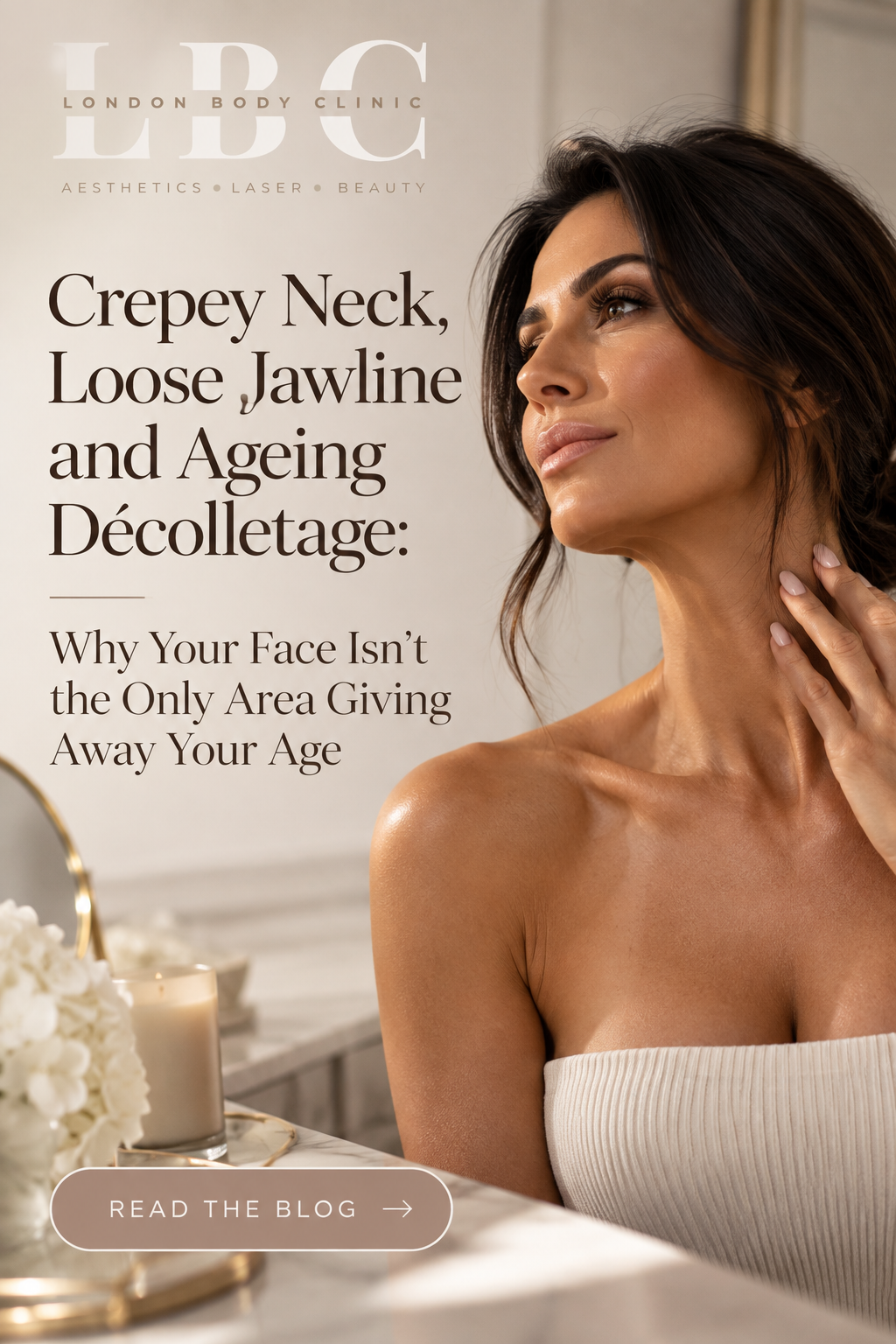
Crepey Neck, Loose Jawline and Ageing Décolletage: Why Your Face Isn’t the Only Area Giving Away Your Age
By London Body Clinic | Aesthetics, Laser & Beauty
You moisturise your face. You use SPF. You have a carefully chosen skincare routine. Perhaps you’ve even started having aesthetic treatments to soften the signs of ageing on your face.
Then one day you catch yourself in a photograph and notice something else.
Your neck.
The skin looks thinner than it used to. Your jawline isn’t quite as defined. Fine lines are appearing across your chest. The area underneath your chin seems looser, and suddenly the skin from your jawline down doesn’t seem to match the face you’ve spent years looking after.
If you’re noticing crepey neck skin, a loose jawline, neck wrinkles or an ageing décolletage, you’re certainly not the only one.
At London Body Clinic, we regularly see women who aren’t necessarily looking to dramatically change their appearance. They simply feel that their neck, jawline or chest is starting to make them look older than they feel.
The good news is that understanding why these changes happen is the first step towards deciding whether you want to do anything about them.
Why Does the Neck Start Ageing?
The neck can be one of the first areas to show visible signs of ageing.
As we get older, the skin changes. Collagen and elastin – proteins involved in the skin’s structure and elasticity – decline with age. Sun exposure also contributes to visible skin ageing over time.
The result can be skin that looks thinner, less firm and increasingly crepey.
And while many of us have spent years protecting our faces, the neck hasn’t always received the same attention.
Think about your morning skincare routine.
Cleanser? Face.
Serum? Face.
Moisturiser? Face.
SPF? Often face.
Then everything stops at the jawline.
Years later, the difference can become much more noticeable.
Why Is My Jawline Becoming Less Defined?
A changing jawline isn’t necessarily caused by one thing.
Ageing affects multiple layers of the face. Changes can occur in the skin, facial fat, muscles and underlying structural support.
This means that what looks like simply “loose skin around the jawline” may actually involve several factors.
For some people, skin laxity is a significant contributor. For others, changes in facial volume, the lower face, under-chin area or general facial proportions can affect how defined the jawline appears.
Weight loss can also make previously stretched or lax skin more noticeable.
This is precisely why an assessment matters.
Two women can both walk into an aesthetics clinic saying:
“I hate my jowls.”
Yet the reason they have developed them – and therefore the treatment that may be appropriate – can be completely different.
At London Body Clinic, we believe treatment should start with understanding the concern rather than simply choosing whichever procedure happens to be trending on social media.
What Is Crepey Skin?
“Crepey” skin describes skin that appears thin, finely wrinkled or crinkled, sometimes resembling crepe paper.
It can be particularly noticeable when you move your neck, turn your head or look down.
Clients often tell us:
“My neck suddenly looks old.”
In reality, it usually hasn’t happened overnight. Gradual changes can simply reach the point where we suddenly begin noticing them.
Age, genetics, sun exposure, skin quality and weight changes can all contribute.
And this brings us to an important point:
A neck line isn’t necessarily the same thing as loose skin.
Someone may have predominantly horizontal neck lines. Another person may have general skin laxity. Someone else may be bothered by crepey texture, while another may have a combination of concerns.
That’s why searching for “the best treatment for an ageing neck” doesn’t necessarily produce one universal answer.
There isn’t one.
And Then There’s the Décolletage
The décolletage – the upper chest area – is another part of the body we frequently forget until visible ageing has already appeared.
It can develop:
- Fine lines and wrinkles
- Crepey texture
- Uneven skin quality
- Pigmentation and sun-related changes
- Loss of firmness
- Lines that become particularly visible after sleeping
If you’ve spent years sleeping on your side, you may have noticed vertical lines appearing across the chest in the morning.
At first, they disappear.
Then one day, they don’t disappear quite as quickly.
The décolletage also receives considerable sun exposure, particularly when wearing lower necklines, yet historically many people haven’t applied the same level of sun protection here as they have to their face.
Can Skincare Fix a Crepey Neck?
Good skincare still matters.
Daily sun protection is particularly important because UV exposure contributes to premature skin ageing. Appropriate moisturising and evidence-based skincare ingredients can also support the appearance and condition of the skin.
But skincare and professional aesthetic treatments don’t necessarily do the same job.
A cream cannot reproduce the effects of every clinic-based procedure.
Equally, having an aesthetic treatment doesn’t mean you should abandon good skincare.
We prefer to think about skin ageing as a long-term strategy, rather than searching for one miracle product or procedure.
What Treatments Can Help a Crepey Neck and Loose Jawline?
The right treatment depends on what is actually causing the concern.
At London Body Clinic, some of the options that may be considered following consultation include treatments such as Morpheus8 RF microneedling, HIFU, skin boosters and other skin rejuvenation approaches.
Not everybody will be suitable for every treatment.
Morpheus8 RF Microneedling
Morpheus8 combines microneedling with radiofrequency energy and is used for skin remodelling and concerns including skin texture and laxity.
For someone bothered by the appearance of crepey neck skin, skin quality or mild-to-moderate laxity, RF microneedling may be one option considered following assessment.
Treatments are commonly performed as a course rather than expecting one session to solve every concern.
The number of treatments recommended and expected outcome will depend on the individual.
HIFU
HIFU – High-Intensity Focused Ultrasound – is another technology used in aesthetic practice for skin tightening and lifting indications in suitable clients.
It works differently from RF microneedling, so the question shouldn’t simply be:
“Is Morpheus8 or HIFU better?”
A better question is:
“Which treatment is more appropriate for my skin, concern and goals?”
Suitability must be assessed individually because HIFU isn’t appropriate for everyone.
Skin Boosters
Where the main concern is skin quality, hydration and fine lines rather than significant laxity, a practitioner may consider skin boosters as part of a treatment plan.
Again, they shouldn’t be confused with dermal filler.
Skin boosters are generally used to support skin quality rather than create the kind of structural volume associated with traditional dermal fillers.
For some clients, the best approach may involve addressing different concerns separately rather than expecting one treatment to do everything.
“But I Don’t Want to Look Done”
This is one of the biggest concerns we hear from women considering aesthetics in their 40s and 50s.
They don’t necessarily want somebody to notice they’ve had treatment.
They want somebody to say:
“You look really well.”
There’s a significant difference.
Treating an ageing neck or jawline doesn’t have to mean dramatically changing your face.
In fact, this is exactly why we believe consultation and treatment planning are so important.
Sometimes the right recommendation is a treatment.
Sometimes it is a combination of approaches.
Sometimes it is waiting.
And sometimes the correct answer is that a non-surgical treatment is unlikely to achieve the degree of change somebody wants.
A responsible practitioner should be comfortable saying that.
Why Treating the Face Alone Can Sometimes Look Unbalanced
This is something women often don’t consider when they first begin having aesthetic treatments.
If significant attention is given to the face over several years while the neck and décolletage are completely ignored, differences in skin quality can become increasingly apparent.
That doesn’t mean everybody needs to start treating their entire face, neck and chest.
It means we should look at ageing holistically.
When assessing somebody who wants natural-looking rejuvenation, it can be useful to consider the face, jawline, neck and visible décolletage together rather than viewing every line in isolation.
The goal shouldn’t be to chase every wrinkle.
The goal is to understand what is bothering you.
When Should You Start Treating Your Neck?
There isn’t a magic age.
You don’t suddenly turn 40 and require a neck treatment.
Some people notice changes in their 30s. Others won’t be particularly bothered by their neck until their 50s or beyond.
Genetics, lifestyle, sun exposure, weight changes and individual anatomy all influence how we age.
More importantly, you don’t have to treat something simply because it has changed with age.
Ageing is normal.
Aesthetic treatment is a choice.
If something bothers you, however, seeking a professional consultation earlier can help you understand what you’re actually seeing and what realistic options are available.
Prevention Still Matters
One of the simplest things you can do for the appearance of your neck and décolletage is also one of the least glamorous:
Protect them from excessive sun exposure.
When applying your daily SPF, don’t automatically stop at your chin.
Consider exposed areas of the neck and upper chest too, and follow appropriate sun-protection guidance.
Your skincare routine doesn’t have to end at your jawline either.
The neck and chest deserve attention too.
The London Body Clinic Approach to Neck and Jawline Rejuvenation
At London Body Clinic, we don’t believe every woman over 40 needs filler, Botox, HIFU, Morpheus8 or any other aesthetic treatment.
We believe in looking at the person in front of us.
What are you actually seeing?
What bothers you?
Is it laxity?
Skin texture?
Fine lines?
Volume changes?
The under-chin area?
Your jawline?
Your neck?
Your décolletage?
Or a combination?
Only then can we discuss appropriate options.
Because if your biggest concern is crepey skin, treating you as though your primary problem is facial volume doesn’t make sense.
And if significant skin laxity is the issue, promising that a simple skin-quality treatment will completely tighten everything would create unrealistic expectations.
The best aesthetic treatment plan begins with an honest assessment.
You Don’t Need to Look 25 Again
Perhaps the most important message for our clients is this:
Looking good doesn’t have to mean trying to look decades younger.
Many women coming into London Body Clinic don’t want a different face.
They want their outside to feel a little more aligned with how they still feel inside.
They want to put on a dress without immediately staring at their neck.
They want to see a photograph without automatically zooming into their jawline.
They want to feel confident without somebody looking at them and immediately thinking:
“She’s had work done.”
Natural rejuvenation is not about erasing every sign that you’ve lived.
Sometimes it’s simply about helping you feel a little more like you again.
If you’re concerned about crepey neck skin, a loose jawline, jowls, neck wrinkles or an ageing décolletage, book a consultation with London Body Clinic.
We’ll assess what is actually causing the concern, talk you through suitable options and, just as importantly, tell you when a treatment isn’t right for you.
Frequently Asked Questions
1. What causes crepey skin on the neck?
Crepey neck skin can be influenced by age-related changes in collagen and elastin, genetics, cumulative sun exposure and changes in skin quality. Weight changes can also make laxity more noticeable in some people.
2. What is the best treatment for a crepey neck?
There isn’t one treatment that is best for everybody. Depending on the type and degree of concern, options may include RF microneedling, HIFU, skin boosters or other skin-rejuvenation treatments. A consultation is needed to determine suitability.
3. Can Morpheus8 help loose neck skin?
Morpheus8 combines microneedling and radiofrequency and is used for skin-remodelling indications, including texture and laxity. Whether it is appropriate for your neck depends on your skin, medical history, degree of laxity and treatment goals.
4. Is HIFU good for the neck and jawline?
HIFU may be considered for skin-tightening and lifting indications in suitable clients. It isn’t appropriate for everybody, so treatment should follow a proper consultation and suitability assessment.
5. Can skin boosters be used on the neck?
Certain skin boosters may be used to address skin-quality concerns in areas including the neck, depending on the specific product and individual client. They are generally intended to improve aspects of skin quality rather than replace significant lost volume or surgically tighten loose skin.
6. Why has my jawline started sagging after 40?
Facial ageing involves multiple structures, including skin, fat, muscle and underlying support. Skin laxity, changes in facial volume, genetics and weight changes can all contribute to a less-defined jawline.
7. Can you tighten a sagging jawline without surgery?
Non-surgical treatments may improve certain concerns in appropriately selected clients, but they cannot reproduce the results of surgery. The degree of improvement possible depends on the cause and severity of the concern.
8. How can I improve wrinkles on my décolletage?
Sun protection and appropriate skincare are important foundations. Depending on the type of lines, pigmentation, texture or skin-quality concern, professional treatments may also be considered following assessment.
9. At what age should I start having neck treatments?
There is no correct age. Treatment should be based on your individual concerns, suitability and goals rather than your birthday. Some people never choose to have aesthetic neck treatments at all.
10. Where can I get treatment for a crepey neck and loose jawline in London?
London Body Clinic offers consultations for clients concerned about skin ageing, neck laxity, jawline changes and skin quality. Following assessment, an appropriate personalised treatment plan can be discussed.